
STORY HIGHLIGHTS
- Members of the elite U.S. Army Delta Force carried out the Libya raid
- Al Libi’s wife describes her husband’s capture
- The al Qaeda operative is accused in the 1998 U.S. embassy bombings
- The Somalia raid targeted an Al-Shabaab leader’s home, locals say
(CNN) — [Breaking news alert at 7:47 p.m. Sunday]
The target of the U.S. raid in Somalia was a foreign fighter commander for Al-Shabaab in Somalia named Ikrima, a senior Obama administration official said Sunday. He is a Kenyan of Somali origin and is associated with two now-deceased al Qaeda operatives who played roles in the 1998 embassy bombing in Nairobi and in the 2002 attacks on a hotel and airline in Mombasa.
[Previous story published at 5:13 p.m. ET Sunday]
U.S. forces strike in Libya, Somalia, capture al Qaeda operative
(CNN) — In two operations in Africa nearly 3,000 miles apart, U.S. military forces went after two high-value targets over the weekend.
One operation took place early Saturday in the Libyan capital of Tripoli, when members of the elite U.S. Army Delta Force captured Abu Anas al Libi, an al Qaeda operative wanted for his role in the deadly 1998 bombings of two U.S. embassies in Africa.
In the second raid, a team of U.S. Navy SEALs in southern Somalia targeted the home of the top leader of Al-Shabaab, a terrorist group linked with al Qaeda.
Early-morning capture
Al Libi, 49, was returning to his house after morning prayers around 6:30 a.m. (Friday night ET) when a group of at least 10 men in four vehicles surprised him, his wife told CNN.
Umm Abdul Rahman said some of the men were wearing masks and some weren’t. She said the unmasked men looked like Libyans to her and spoke Arabic with Libyan accents. She couldn’t say whether the other men were Americans.
The capture was over very quickly, she said.
She disputed reports that her husband of 22 years was reaching for a gun when he was taken. She said he broke with al Qaeda in 1996 and had no role in the embassy bombings two years later, and he had even tried recently to clear his name.
The Saturday operation was conducted with the knowledge of the Libyan government, said one U.S. official. The Pentagon said the U.S. military was holding al Libi in a “secure location” outside Libya.

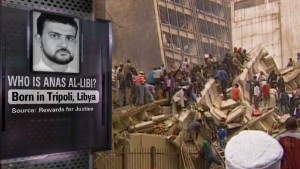 U.S. forces strike in Libya and Somalia
 Bartley: ‘Relieved’ Al Libi captured
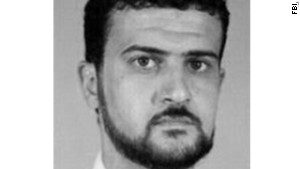 U.S. forces capture al Qaeda figure
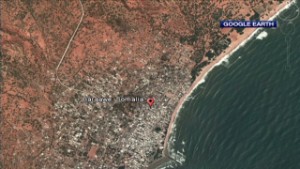 U.S. forces make 2 raids in Africa
He eventually will be taken to New York, a source with knowledge of the capture and proceedings told CNN.
The Libyan interim government called the U.S. capture a kidnapping and has requested an explanation from Washington about the raid, the country’s state news agency reported Sunday. Libya emphasized its citizens should be tried in Libya if they are facing charges, LANA reported.
President Barack Obama approved the two raids, monitored them closely and was updated regularly by homeland security adviser Lisa Monaco and his national security staff, National Security Council spokeswoman Caitlin Hayden told CNN on Sunday.
“This operation should be a clear reminder that the United States will seek justice against those who would attack Americans, and never forgets those who are victims of terrorism,” the White House said Sunday.
And in a written statement Sunday, Defense Secretary Chuck Hagel said the raids “send a strong message to the world that the United States will spare no effort to hold terrorists accountable, no matter where they hide or how long they evade justice.”
“We will continue to maintain relentless pressure on terrorist groups that threaten our people or our interests, and we will conduct direct action against them, if necessary, that is consistent with our laws and our values,” Hagel said.
SEAL Team Six involved in Somalia
In the Somalia raid, local residents said the compound targeted by the Americans was the home of Al-Shabaab leader Mukhtar Abu Zubayr, also known as Ahmed Abdi Godane. While an Al-Shabaab spokesman has claimed Godane was the target of the attack, the U.S. military has not yet disclosed the target.
An administration official told CNN on Sunday that members of the U.S. Navy’s SEAL Team Six — the same unit that killed Osama Bin Laden in Pakistan in 2011 — led the raid. The SEALs came under fire and withdrew before they could confirm whether they killed their target, a senior U.S. official said.
A second administration official said the commandos withdrew to avoid civilian casualties.
The operations were carried out even as polls show Americans are skittish about U.S. military involvement in overseas conflicts. This means others who might be in U.S. crosshairs could have more reason to worry, said retired Lt. Col. Rick Francona, a CNN military analyst.
“One (mission) could have gone without the other,” Francona said. “But the fact that they did them both, I think, is a real signal that the United States — no matter how long it takes — will go after these targets.”
Speaking to reporters at the Asia-Pacific Economic Cooperation summit in Bali, Indonesia, U.S. Secretary of State John Kerry said the raids ought to make clear that the United States “will never stop in its effort to hold those accountable who conduct acts of terror.”
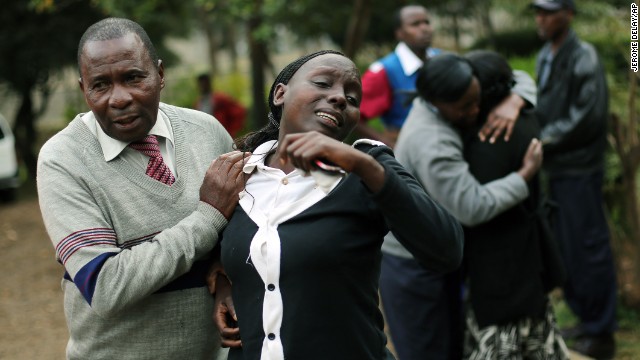 Relatives of Johnny Mutinda Musango, 48, weep after identifying his body at the city morgue in Nairobi, Kenya, on Tuesday, September 24. Musango was one of the victims of the Westgate Mall hostage siege. Kenyan security forces were still combing the mall on the fourth day of the siege by al Qaeda-linked terrorists.
 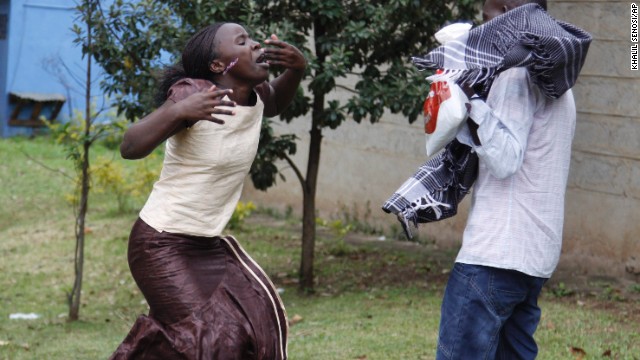 Ann Gakii reacts at the Nairobi City Mortuary after identifying the body of her father, who was killed in the mall attack on Saturday.
 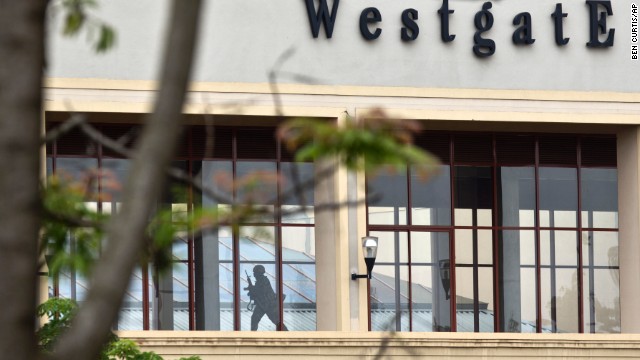 A Kenyan soldier runs through a corridor on an upper floor at the Westgate Shopping Mall in Nairobi, Kenya, on September 24, shortly before an explosion was heard. Sounds of heavy gunfire erupted from the mall Tuesday, even as authorities said they had the building under their control. But four days after Al-Shabaab terrorists stormed the swanky mall, several gunmen — including snipers — were still inside, two senior officials said.
 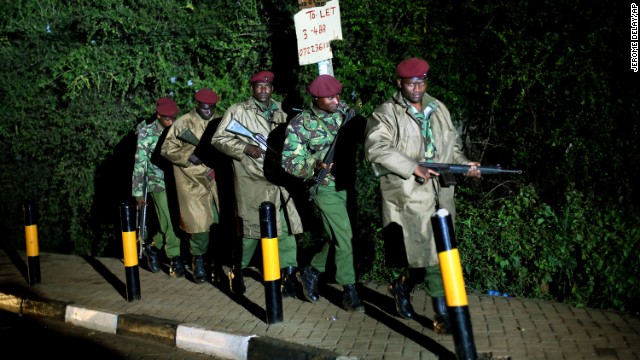 Kenyan Defense Forces walk near the mall on Monday, September 23.
 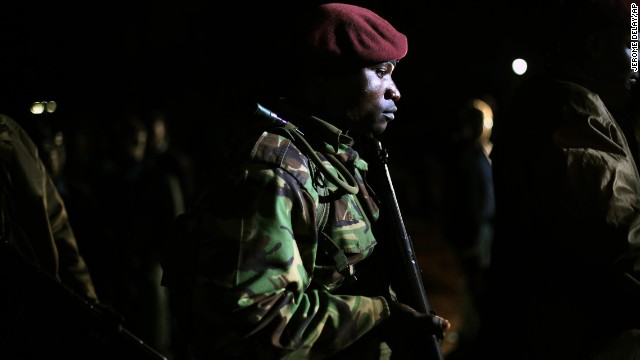 Kenyan Defense Forces leave the mall on September 23.
 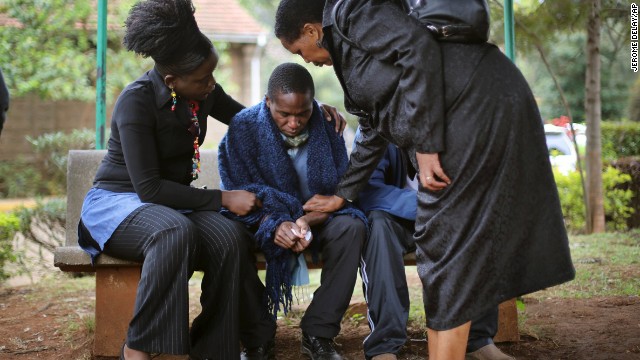 Stephen, center, is comforted by relatives as he waits for the post mortem exam of his father, who was killed in Saturday’s attack at the mall.
 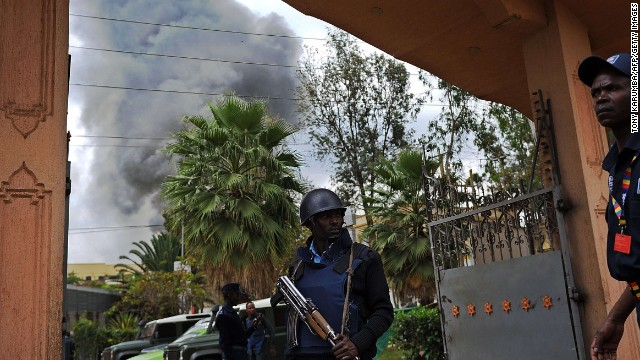 A Kenyan police officer guards the entrance of a building near the mall on September 23.
 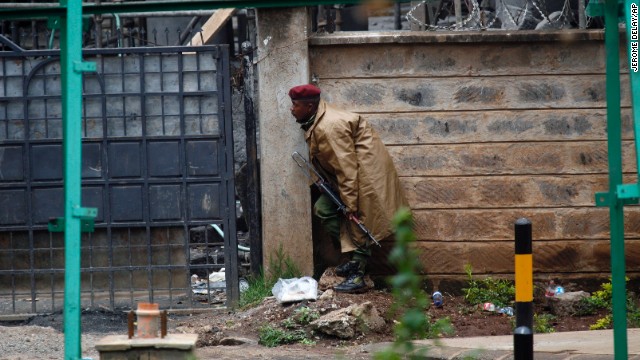 A Kenyan security officer takes cover as gunfire and explosions are heard from the mall on September 23.
 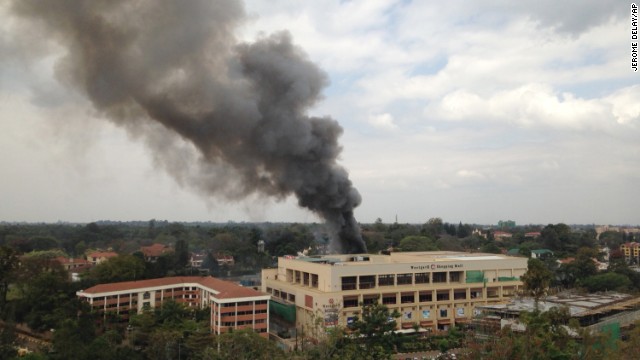 Heavy smoke rises from the Westgate Shopping Mall on September 23.
 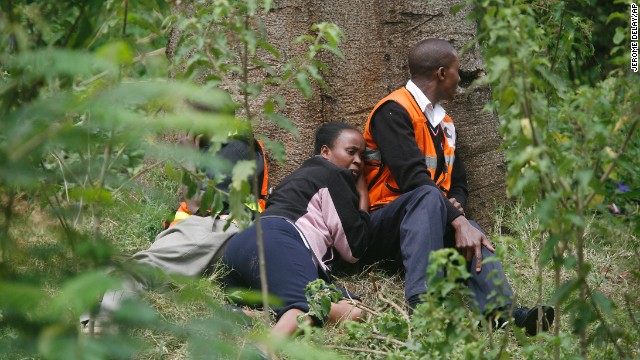 Medics take cover behind a tree as gunfire and explosions are heard from the Westgate Mall on September 23.
 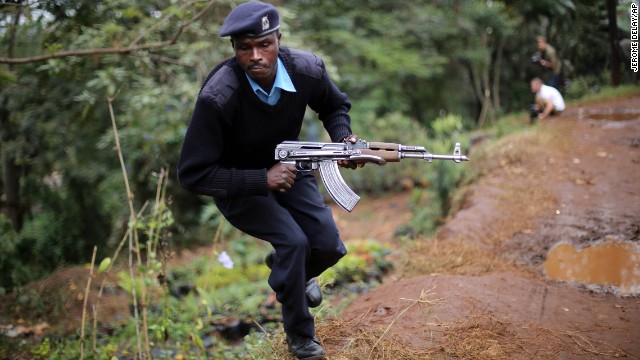 A Kenyan police security officer runs for cover as heavy smoke rises from the mall on September 23.
 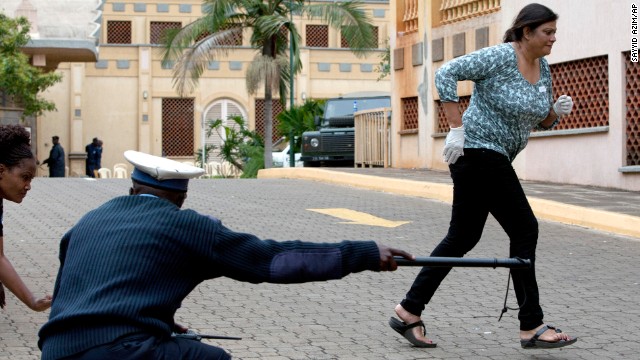 A paramedic runs for cover outside the mall on September 23.
 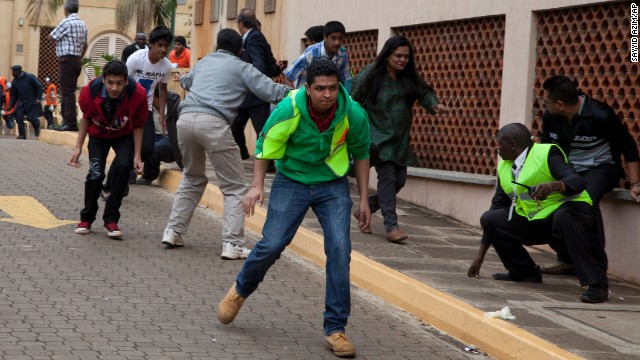 People run for cover outside the mall after heavy shooting started on September 23.
 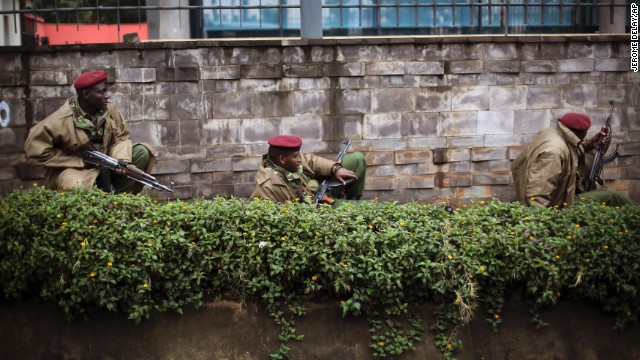 Kenyan security forces crouch behind a wall outside the mall on September 23.
 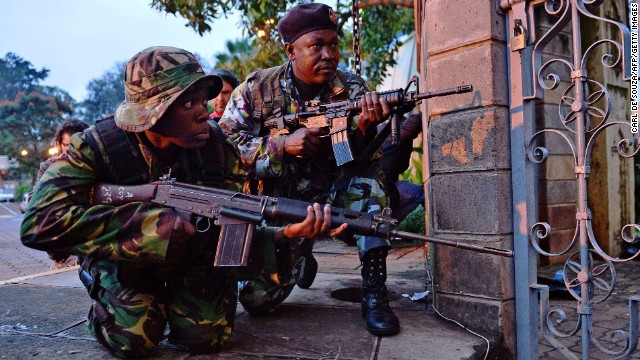 Soldiers take cover after gunfire near the mall on September 23.
 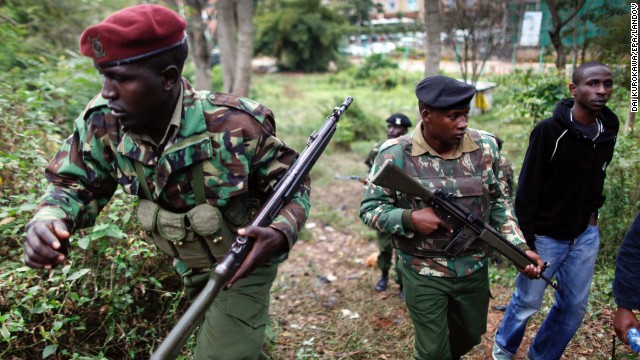 Kenyan paramilitary police officers patrol the area near the mall on Sunday, September 22.
 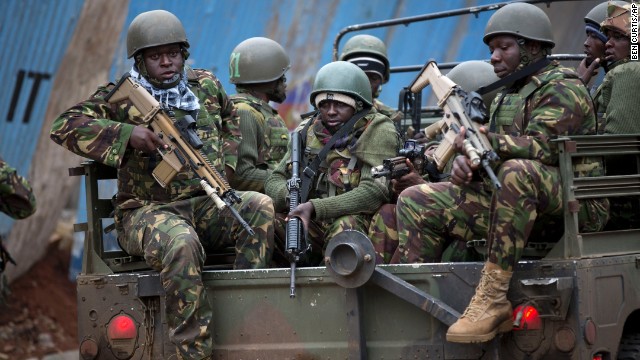 Soldiers from the Kenya Defense Forces arrive outside the Westgate Mall on September 22.
 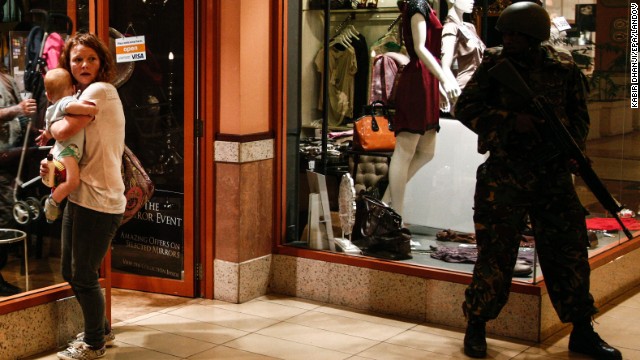 A woman shields a baby as a soldier stands guard inside the Westgate Mall on Saturday, September 21.
 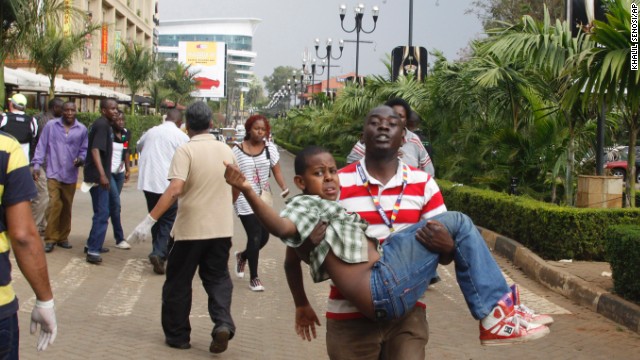 A rescue worker helps a child outside the mall.
 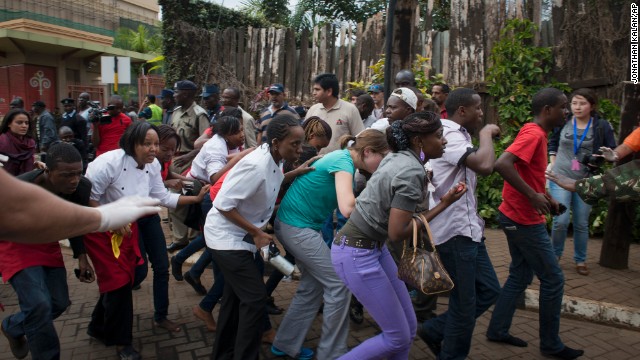 People who had been hiding inside the mall during the gunfire flee the scene.
 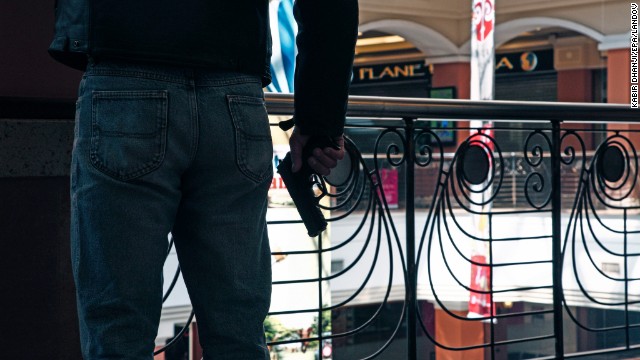 An armed official takes a shooting position inside the mall.
 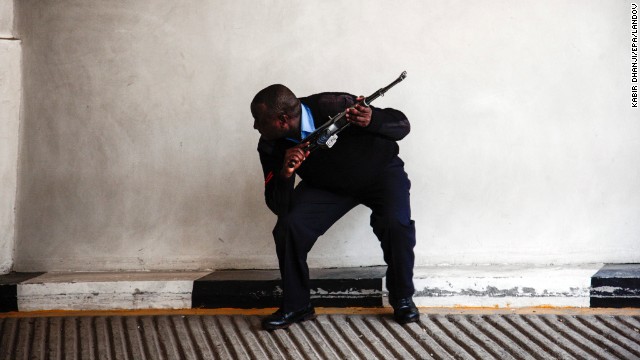 An armed official crouches on September 21.
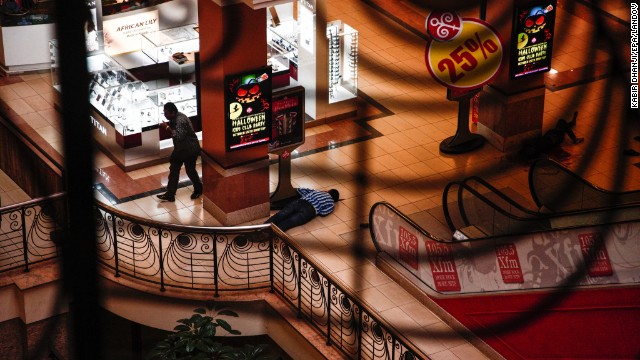 Bodies lie on the ground inside the mall.
 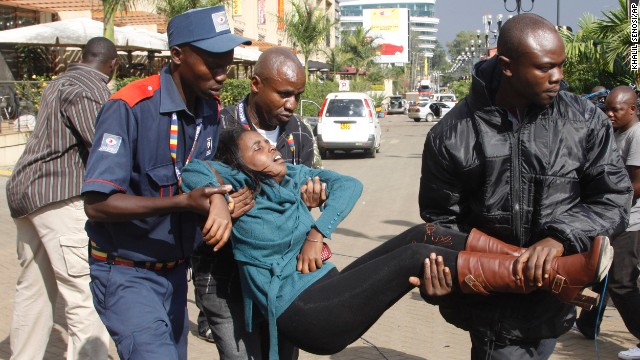 Men help a wounded woman outside the mall.
 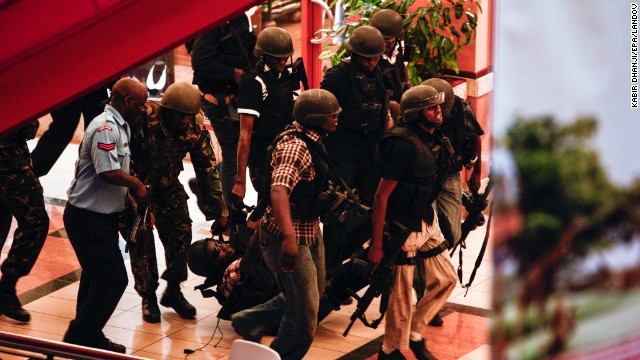 Officials carry an injured man in the mall.
 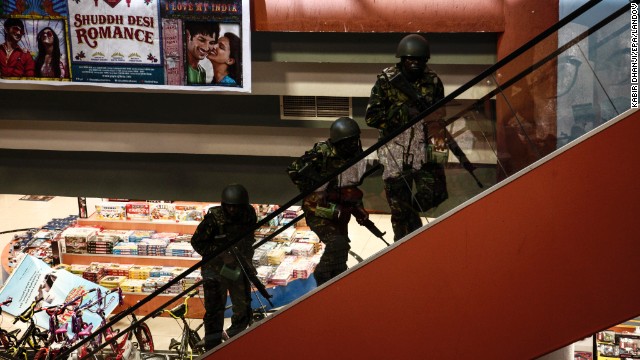 Soldiers move up stairs inside the Westgate Mall.
 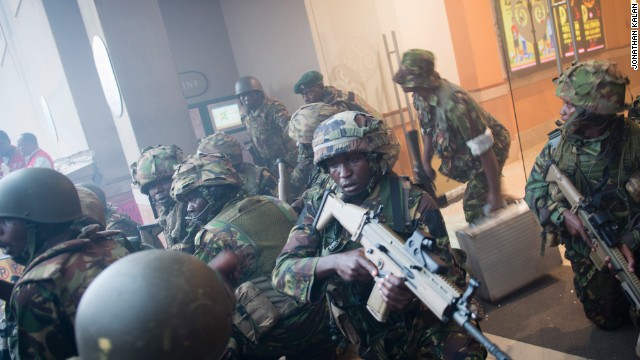 Armed police leave after entering the mall. At least one suspect has been killed, a government official said. Police have said another suspected gunman has been detained at a Nairobi hospital.
 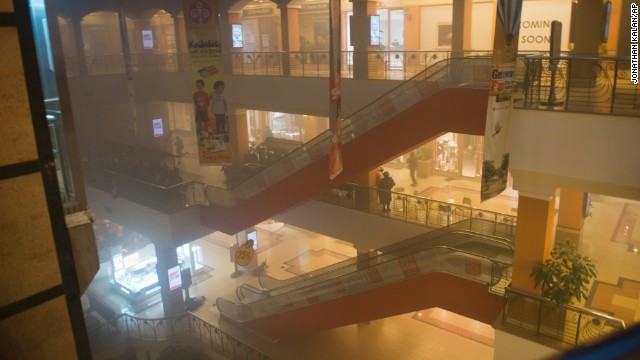 Armed police take cover behind escalators as smoke fills the air. Witnesses say tear gas was thrown in the corridors.
 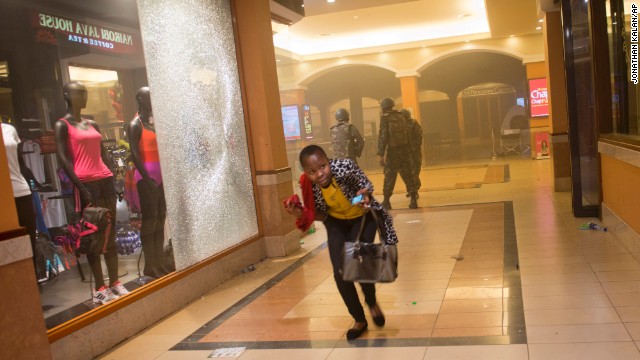 A woman who had been hiding during the attack runs for cover after armed police enter the mall.
 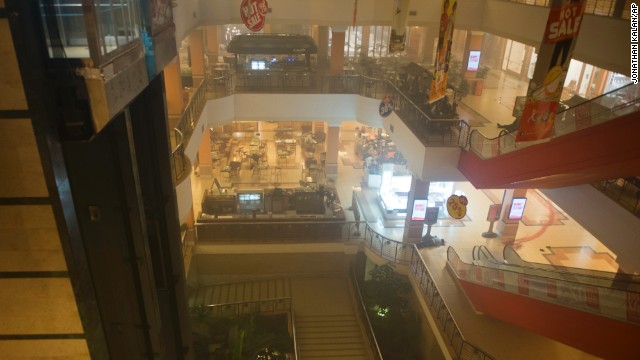 A body is seen on the floor inside the smoke-filled four-story mall.
 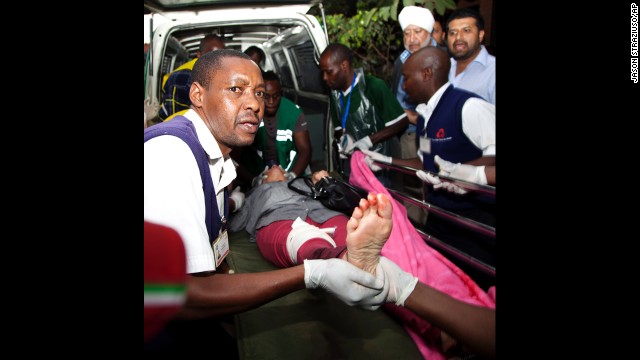 An injured person is helped on arrival at the Aga Khan Hospital in Nairobi after the attack at the upscale mall.
 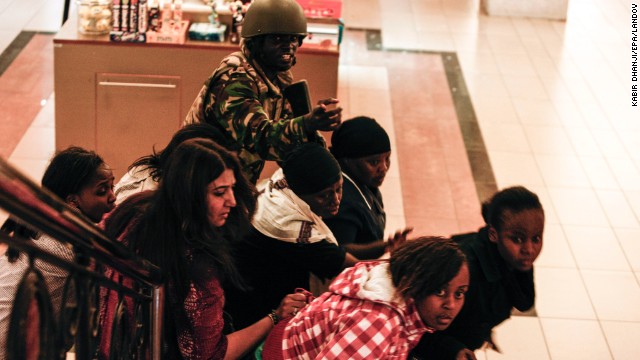 A soldier directs people up a stairway inside the Westgate on September 21.
 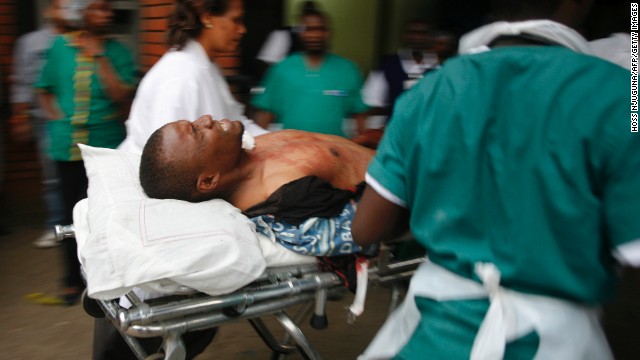 An injured man is wheeled into the Aga Khan Hospital in Nairobi.
 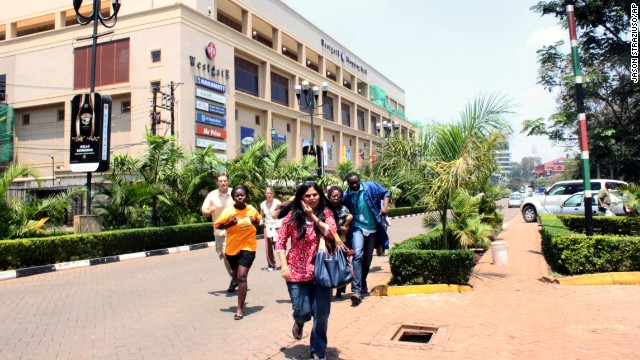 People run from the Westgate Mall.
 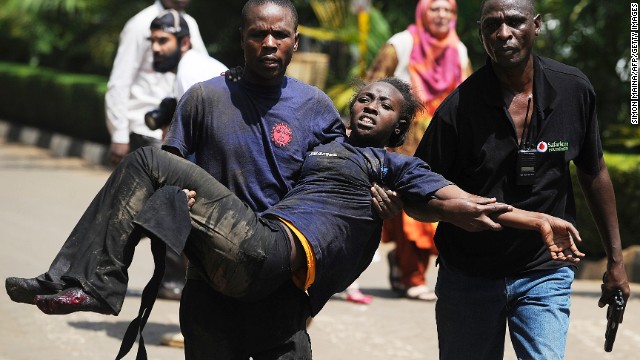 A Kenyan woman is helped to safety after the masked gunmen stormed the upscale mall and sprayed gunfire on shoppers and staff.
 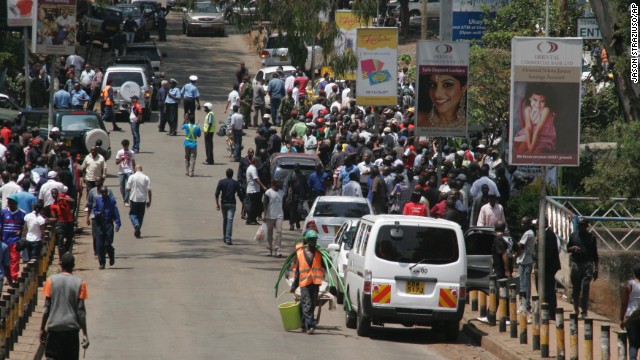 Crowds gather outside the upscale shopping mall. The interior ministry urges Kenyans to keep off the roads near the mall so police can ensure everyone inside has been evacuated to safety.
 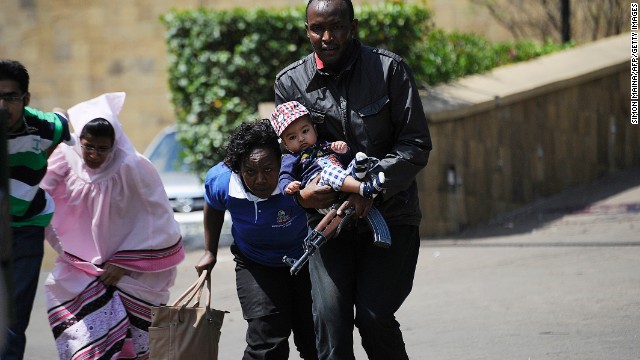 A policeman carries a baby to safety. Authorities said multiple shooters were at the scene.
 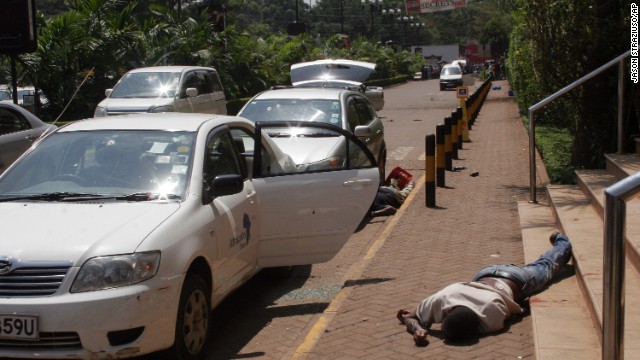 Bodies lie outside the shopping mall.
 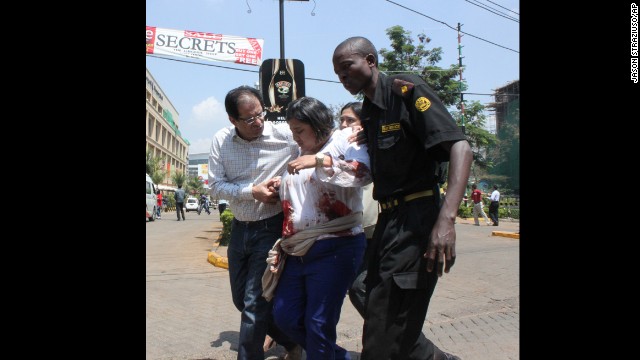 A security officer helps a wounded woman outside.
 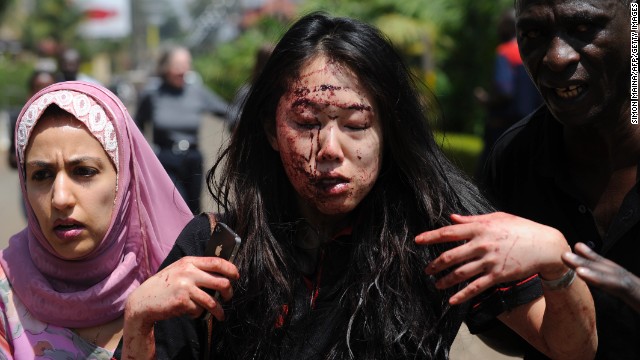 Elaine Dang of San Diego is helped to safety after the attack. The military asked local media not to televise anything live because the gunmen are watching the screens in the mall.
 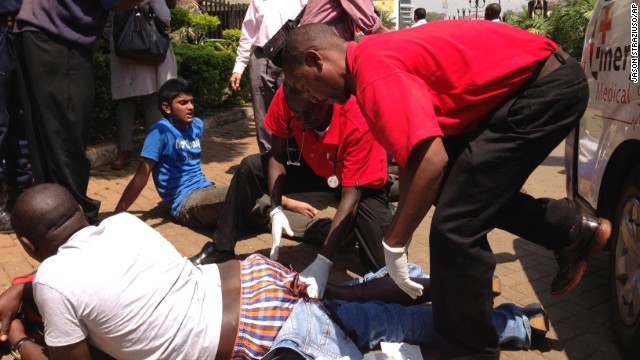 Paramedics treat an injured man outside the mall.
 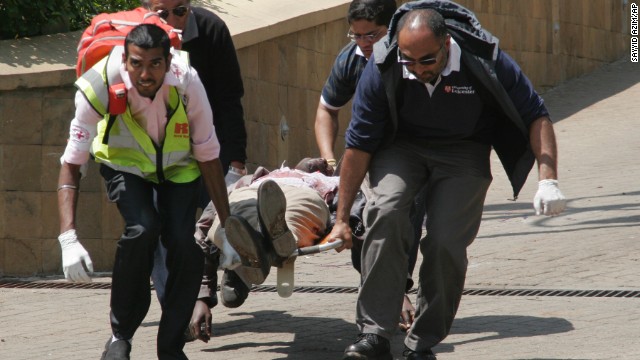 Medical personnel carry a body away.
 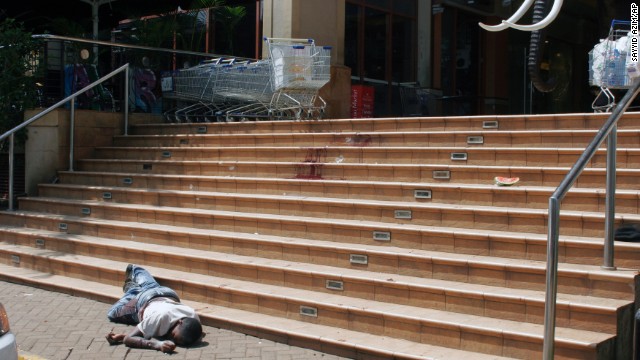 A body lies outside the mall. Gunmen shot people outside the mall as they entered it
 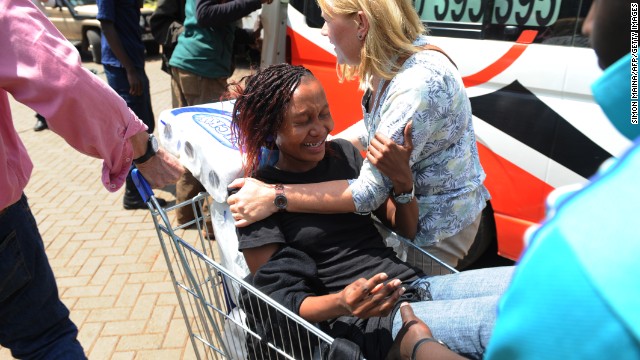 A woman is pulled by a shopping cart to an ambulance.
 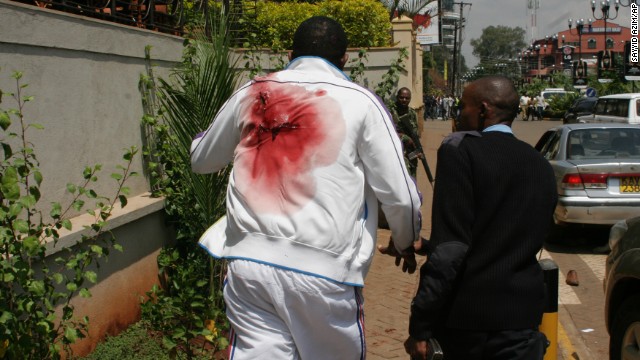 A wounded man is escorted outside the mall.
 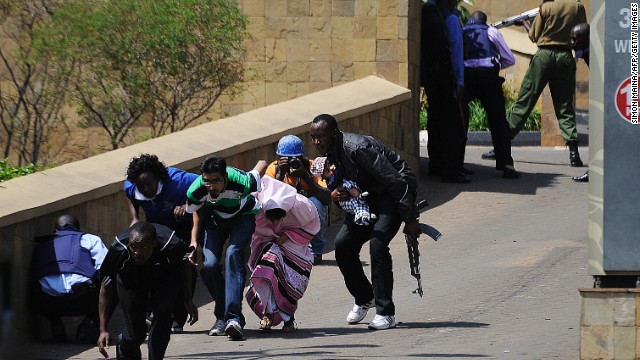 A police officer carries a baby as people keep low and run to safety. Crowds dashed down the streets as soldiers in military fatigues, guns cocked, crawled under cars to get closer to the mall.
 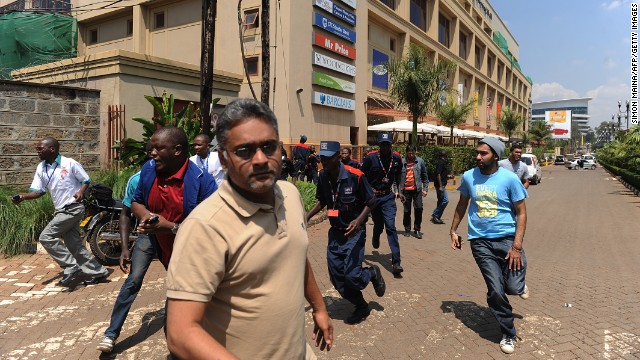 People run away from the scene.
 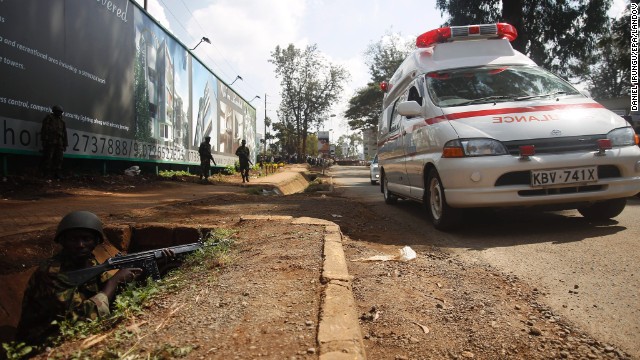 Armed Kenyan forces take position to secure the area around the shopping mall as ambulances move in to carry the injured.
 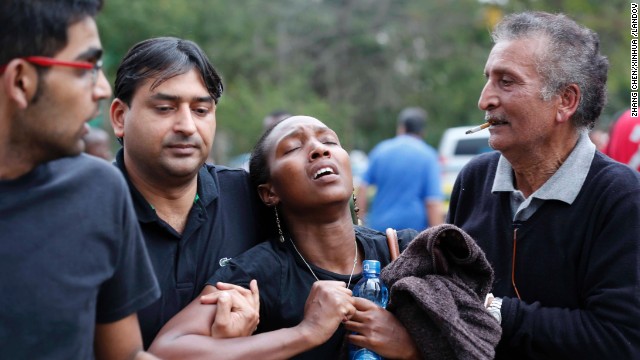 A woman reacts after she is rescued from the mall.
 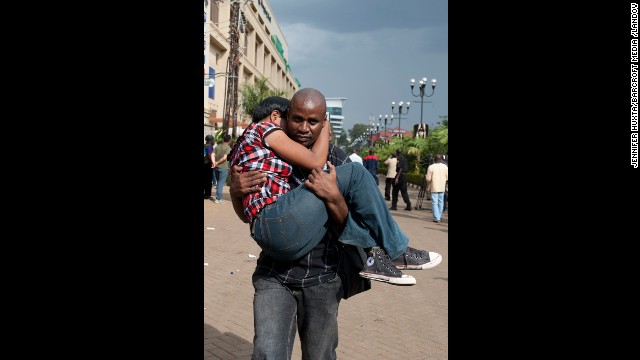 A couple flee the area. As night fell, authorities said they had cornered the gunmen in the mall.
 Kenya mall attack
Kenya mall attack
Kenya mall attack
Kenya mall attack
Kenya mall attack
Kenya mall attack
Kenya mall attack
Kenya mall attack
Kenya mall attack
Kenya mall attack
Kenya mall attack
Kenya mall attack
Kenya mall attack
Kenya mall attack
Kenya mall attack
Kenya mall attack
Kenya mall attack
Kenya mall attack
Kenya mall attack
Kenya mall attack
Kenya mall attack
Kenya mall attack
Kenya mall attack
Kenya mall attack
Kenya mall attack
Kenya mall attack
Kenya mall attack
Kenya mall attack
Kenya mall attack
Kenya mall attack
Kenya mall attack
Kenya mall attack
Kenya mall attack
Kenya mall attack
Kenya mall attack
Kenya mall attack
Kenya mall attack
Kenya mall attack
Kenya mall attack
Kenya mall attack
Kenya mall attack
Kenya mall attack
Kenya mall attack
Kenya mall attack
Kenya mall attack
Kenya mall attack
Kenya mall attack
Kenya mall attack
Kenya mall attack
Kenya mall attack
Kenya mall attack
HIDE CAPTION
<<
<</span>

1

2

3

4

5

6

7

8

9

10

11

12

13

14

15

16

17

18

19

20


>
>>
Photos: Kenya mall attack 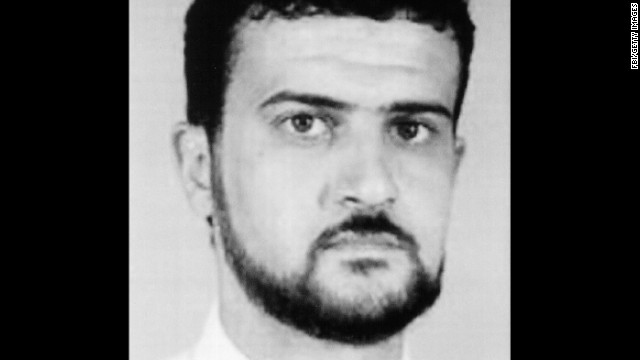 Abu Anas al Libi, a key al Qaeda operative wanted for his role in the bombings of U.S. embassies in Kenya and Tanzania in 1998, has been captured in a U.S. special operations forces raid in Tripoli, Libya, U.S. officials told CNN on Saturday, October 5.
 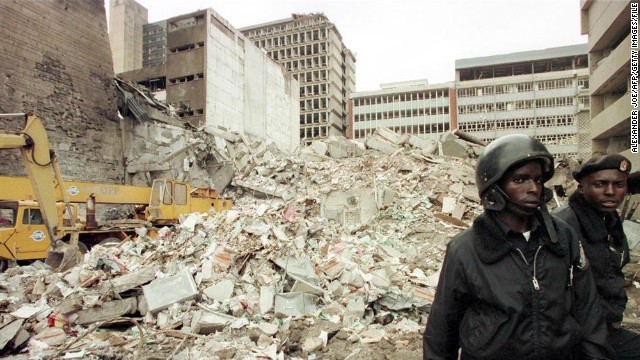 The blast on August 7, 1998 at the U.S. Embassy in Nairobi, Kenya, killed more than 200 people. Kenyan security guards keep watch on August 8, 1998, at the scene of explosion.
 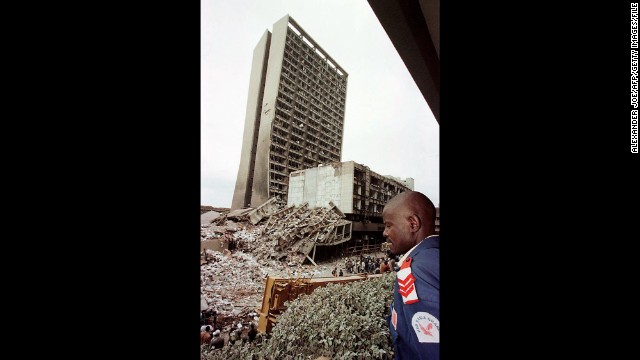 A guard looks over the site of the bomb blast on August 8, 1998, in Nairobi, Kenya.
 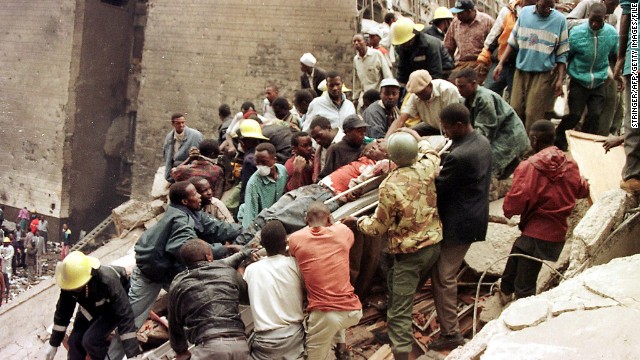 Rescuers help move survivors from the explosion site in Nairobi, Kenya, on August 7, 1998.
 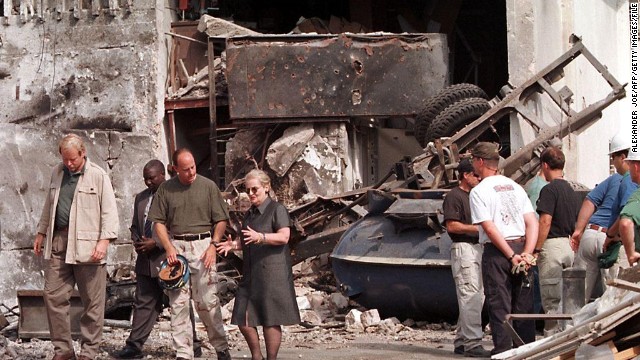 The Tanzania blast went off nearly simultaneously, to the one in Kenya on August 7, 1998, leaving 11 people dead. Here, U.S. Secretary of State Madeleine Albright talks with a member of the FBI at the U.S. Embassy in Dar es Salaam on August 18, 1998. Visible in the background is the tanker that was used to create the explosion.
 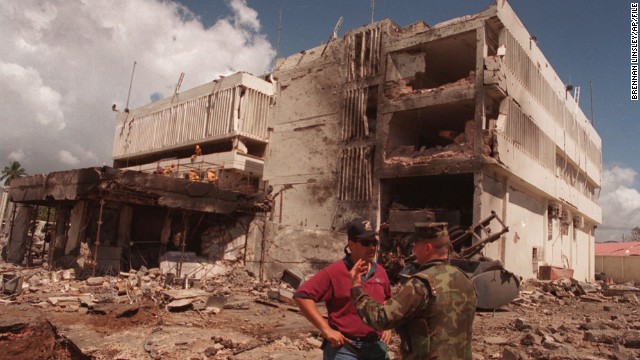 A U.S. Marine talks with an FBI investigator in front of the bomb-damaged U.S. Embassy in Dar es Salaam, Tanzania, on August 15, 1998.
 Al Qaeda leader captured
Al Qaeda leader captured
Al Qaeda leader captured
Al Qaeda leader captured
Al Qaeda leader captured
Al Qaeda leader captured
HIDE CAPTION
<<
<</span>

1

2

3

4

5

6
>
>>
Photos: Al Qaeda leader captured “Those members of al Qaeda and other terrorist organizations literally can run,” he said, “but they can’t hide.”
Al Libi tied to U.S. embassy bombings
Al Libi, has been on the radar for years. He was on the FBI’s “Most Wanted Terrorists” list, with a $5 million reward offered for information leading to his arrest or conviction.
He is alleged to have played a key role in the August 7, 1998, bombings of American embassies in Nairobi, Kenya, and Dar es Salaam, Tanzania. More than 200 people were killed and another 5,000 wounded in the Kenya attack; 11 died in the Tanzania incident.
Al Libi has been indicted on charges of conspiracy to kill U.S. nationals, murder, destruction of American buildings and government property, and destruction of national defense utilities of the United States.
As early as December 2010, Libyan authorities told a United Nations committee that al Libi was living there, even providing a Tripoli address for him.
U.S. officials wanted al Libi to face trial in an American court.
But, counterterrorism analysts told CNN, he may not have been apprehended at the time because of the delicate security situation in much of Libya. There, ex-jihadists — especially those who once belonged to the Libyan Islamic Fighters Group — held considerable sway after the ouster of longtime leader Moammar Gadhafi.
“It’s a huge deal to get him,” said CNN’s Nic Robertson, who has long been covering al Qaeda. “He’s a big player in al Qaeda (and) he is in one of the key target areas, the north of Africa.”
Beyond any psychological impact on the terrorist group, al Libi’s capture could potentially yield a wealth of information about al Qaeda’s plans and capabilities. The terrorist network has shown particular strength of late in Africa.
“Clearly, he may have useful information about the strength of al Qaeda and the Islamists in Libya,” Robertson said. “He is somebody who is senior within al Qaeda. He was well respected, a good operative.”
Al-Shabaab blamed for Kenya mall attack
Al-Shabaab long has been a target of Washington as well: It was designated a foreign terrorist organization in 2008. The group is seeking to turn Somalia into a fundamentalist Islamic state, though it has carried out attacks in other African countries as well.
The attack on Nairobi’s Westgate Mall on September 21 thrust Al-Shabaab into the spotlight once again. Washington vowed to support Kenya’s government after the bloody raid, which killed at least 67 people.
The Navy SEAL raid on Al-Shabaab took place before dawn Saturday (late Friday night ET) in the southern Somalian port city of Barawe. Abdiaziz Abu Musab, an Al-Shabaab spokesman, said at least one Al-Shabaab fighter was killed in the gunfight. But no U.S. personnel were injured or killed, a U.S. official said.
In recent months, Al-Shabaab’s haven in south-central Somalia has been been increasingly squeezed as Kenyan forces fight the group from the south and African Union forces come down from Mogadishu, the Somali capital.
At the same time, Al-Shabaab has become even more closely aligned with al Qaeda. The two groups effectively merged last year, said CNN national security analyst Peter Bergen.
“This is a group that has adopted al Qaeda’s ideology wholesale,” Bergen said. “The reason they attacked the mall was not only because it was Kenyan, but also because it attracted a fair number of Western businessmen and others living in Nairobi.”
‘Most Wanted Terrorist’ al Libi nabbed in native Libya after years tied to al Qaeda
U.S. officials: Navy SEALs launch raid on Al-Shabaab leader
CNN’s Elise Labott, Holly Yan, Melissa Gray and Mayra Cuevas contributed to this report
Continued:
Somali raid target was ‘Ikrima’
The post Somali raid target was ‘Ikrima’ appeared first on Arne Ruhnau News.
via Arne Ruhnau News http://arneruhnau.com/somali-raid-target-was-ikrima/

No comments:
Post a Comment