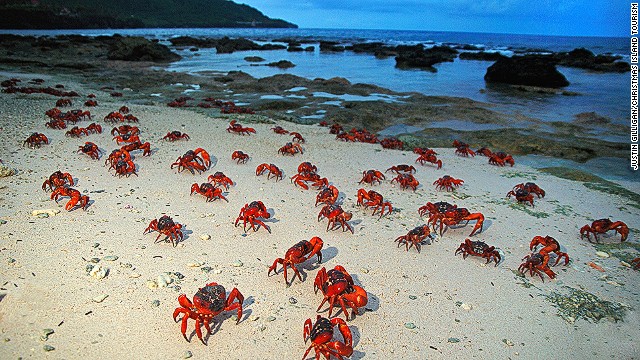
 Millions of red crabs living on Australia’s Christmas Island make their way to the sea to mate and, eventually, lay their eggs.
  Over a million wildebeests trek north in the Serengeti each year and attempt to cross the Grumeti River. The water is infested with crocodiles, and many of the animals fall victim to the aquatic predators.
  When starlings make their yearly winter migration, they travel en-masse. Some equate their unusual formations to an aerial ballet. Last January, they traveled to Israel — the first time they’d visited the country in 20 years.
  Sea turtles often migrate hundreds (sometimes thousands) of miles between their breeding and feeding grounds. Freshly hatched baby turtles will head to the sea to find cover from predators and a ready food source. Green sea turtles in Indonesia (pictured) face an added danger from poachers, who can turn a high profit by trading turtle eggs.
 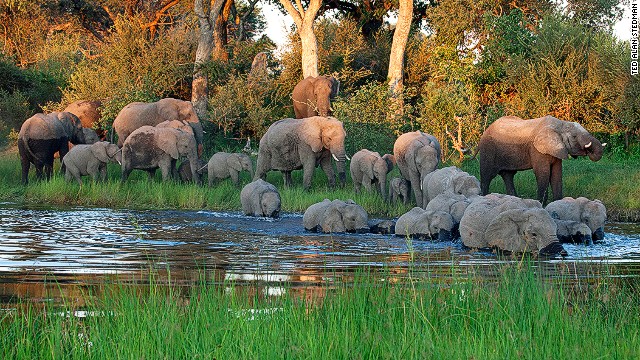 Elephants migrate thousands of miles to find food and mate. Over the years, human development has destroyed many migratory routes. One area that still attracts pachyderms far and wide, however, is Minneriya, Sri Lanka, which bears witness to a great gathering of elephants come August.
  Thousands of monarch butterflies descend into Pacific Grove, California from October, and stay throughout the winter months. Around Valentine’s Day, the butterflies stick around to perform their mating rituals.
  Between June and November, humpback whales undertake a seasonal migration from the Antarctic Peninsula to the equatorial coast of Colombia to breed, feed and rest.
  Greater sandhill cranes migrate to the San Luis Valley in Colorado late winter every year. More than 25,000 cranes stop to rest and feed as they travel from their wintering grounds of Mexico, Arizona and New Mexico to their summer homes in the northern Rocky Mountains.
  Migratory birds, greater flamingos rest at the Nal Sarovar Bird Sanctuary near Ahmadabad. Mainly inhabited by migratory birds in winter and spring, it is the largest wetland bird sanctuary in Gujarat, and one of the largest in India.
  The sardine run along South Africa’s east coast is an annual event attracting thousands of locals and tourists. Each year massive shoals of sardines stretching hundreds of miles draw sharks, dolphins and gannets hovering above the fish.
 HIDE CAPTION
A sideways view
Serengeti stampede
Aerial ballet
Sea turtle spotting
Pachyderm parade
Mating monarchs
Whale of a time
Crane your neck
Flaming flamingos
Run, sardine, run!
<<
<</span>

1

2

3

4

5

6

7

8

9

10
>
>>
STORY HIGHLIGHTS
- Animals migrate to breed, feed, mate, and various other essentials to survival.
- Sometimes, migrations attract predators, as with the sardine run in South Africa.
- Some communities, like in Pacific Grove, California, impose fines on anyone disrupting the local fauna.
- Locals on Christmas Island kickback with a beer during the annual crab migration.
(CNN) — There is something magical about animal migrations. Perhaps it’s the fact that as more of us move to cities (The U.N. predicts that nearly 70% of the global population will be urban dwellers by 2050), the sight of congregating herds, schools of fish, or flocks of birds is increasingly rare. Or maybe witnessing animals cross great distances to eat, mate, breed and, in essence, survive helps us to take stock of our own lives.
Whatever the reason, when animals come together, very often so do humans. Here’s our guide to the animal migrations that bring people out in flocks.
Butterfly kingdom
Residents of Pacific Grove, California, take their butterflies very seriously. The area offers a warm micro-climate that attracts 20,000 monarch butterflies who travel up to 2,000 miles to winter in the region. In fact, the annual phenomenon has earned Pacific Grove the nickname “butterfly town”.
“I always hear that the monarchs are coming before I ever see one. I get emails saying, ‘I saw my first monarch of the season!’ Everyone wants to be the one to herald their return,” says Lori Mannel, executive director of the Pacific Grove Museum of Natural History. The season sees an influx of tourists as well. During the winter months, nearly 100,000 visitors come to witness the spectacle.
The last few years has seen a drastic decline in their population, a fact some credit with the degradation of milk weed — the only flora monarchs can lay their eggs on. To help restore the population, many locals have started replanting the stuff, while the local government has instilled a $1,000 fine for disturbing a monarch.
Where: California
When: October – February
Read more: World’s weirdest food festivals
Run, sardine, run

A school of sardines make their move during the annual sardine run in southern Africa. (Image: Junko Kimura/Getty Images)
The east coast of southern Africa bears witness to one of the greatest migrations of all time: the sardine run. From May through July, millions of sardines spawn in the Agulhad Bank and make their way north up the coast.
The migration also attracts predators, both of the human and animal variety. Each year, thousands of locals and tourists perch with massive fishing nets to catch the unwitting fish. Joining their ranks are sharks, dolphins and gannets, who also hover nearby in the hopes of snagging an easy dinner.
Where: South Africa
When: May – July
Sign of the wildebeest
While tourism isn’t always a welcome phenomenon for environmentalists, there are some instances where conservation efforts are abetted by traveler interest. In the Serengeti, for instance, the tens of thousands of visitors that stream in July and August for the Great Migration (so called for the millions of wildebeests that trek from Tanzania to Kenya) actually help to ensure funding goes to conservation.

A heard of zebras clensh their thirst en route to Kenya in their annual great migration across the Serengeti. (Image: MarcoLongari/AFP/Getty Images)
“You could argue that tourism is one of the major reasons this huge ecosystem still exists today,” says Craig Sholley, the vice president of philanthropy and marketing at the African Wildlife Fund.
I always hear that the Monarchs are coming before I ever see one.
Lori Mannel, Pacific Grove Museum of Natural History
At the peak of the migration, the banks of the Grumeti River are lined with hundreds of vehicles packed with environmental voyeurs all eager to glimpse the beasts make the life-threatening swim across the currents.
Where: Tanzania and Kenya
When: July – August
Read more: World’s weirdest food festivals
Crab season
Christmas Island is perhaps best known for the swarm of red crabs that pour onto the roads and beaches every winter.
“It looks like someone came along and planted all these crabs overnight,” explains Linda Cash, the marketing manager at Christmas Island Tourism.
When the crabs come out, the atmosphere becomes positively festive, notes Cash. The roads are closed to protect the journeying numbers, and the park builds special bridges to help them cross safely.
“People come down at night with their rakes, move the crabs off the road and share a beer,” she says.
Where: Christmas Island
When: October – November
A whale of a time

A group of whale spotters hit the humpback whale jackpot whilst during the annual whale migration in South America. (Image: Rodrigo Buendia/AFP/Getty Images)
As it happens, humpback whales are a species constantly on the move. This is good news for tourists, who have a plethora of choice for where and when they’d like to engage in whale watching activities.
In the summer months, Colombia’s Pacific Coast becomes a hotbed for roughly 3,000 of the journeying mammals, who use the warm waters as their mating grounds. Australia makes another popular spot to glimpse the majestic creatures, who hug the coast from July onwards. The whales can travel over 5,000 miles, and often, savvy businesses set up cruises and watch towers to help visitors get a peek.
Where: Colombia and Australia
When: July – October (Colombia), June – November (Australia)
Originally posted here:
World’s must-see animal migrations
The post World’s must-see animal migrations appeared first on Arne Ruhnau News.
via Arne Ruhnau News http://arneruhnau.com/worlds-must-see-animal-migrations/

No comments:
Post a Comment