
STORY HIGHLIGHTS
- Protesters across Egypt have demanded that President Mohamed Morsy resign
- The Muslim Brotherhood has responded with ‘insane religious rhetoric’, writes Dalia Ziada
- Many Egyptian people believe that the army is not interested in having a political role
- Ziada: One mistake was to accelerate democratization by rushing into presidential vote
Editor’s note: Dalia Ziada is an Egyptian liberal human rights activist and executive director of the Ibn Khaldun Center for Development Studies in Cairo. She has received several international awards and last year was named by CNN as one of the Arab World’s eight “Agents of Change.”
Cairo (CNN) — For the fourth successive day, millions of people packed Cairo’s Tahrir Square and similar sites across Egypt Wednesday, calling for President Mohamed Morsy’s immediate resignation and for presidential elections to be held in the near future.
Already the protests have paid off quicker than anyone expected. In a scenario similar to when President Hosni Mubarak was toppled during the first wave of revolution in 2011, the military has abandoned Morsy and announced its complete backing and support for the demands of the people.
Dalia Ziada
On Monday the defense minister gave Morsy and his regime 48 hours to respond to the people’s demands, leaving the current rulers in utter shock and confusion. Soon after this statement was broadcast on national television, many people were congratulating each other, celebrating the return of the military and counting down the hours, minutes and seconds till the Muslim Brotherhood relinquish power. Other major institutions like the police, the church and the judiciary have announced a similar approach towards the demands of the people and applauded the statement from the military.

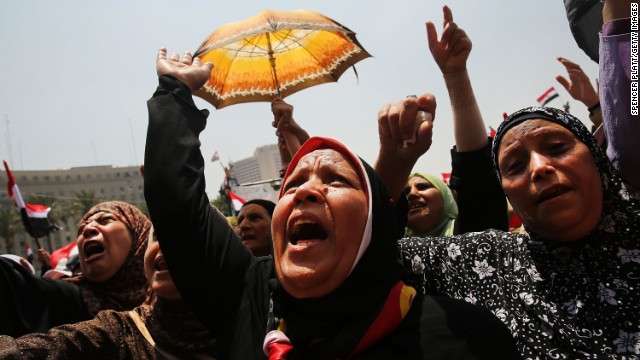 Hundreds of protesters gather in Tahrir Square in Cairo as the deadline given by the military to Egyptian President Mohamed Morsy approaches on Wednesday, July 3. On Monday, the Egyptian military gave Morsy a 48-hour ultimatum to accommodate his opponents with a power-sharing agreement or be pushed aside.
 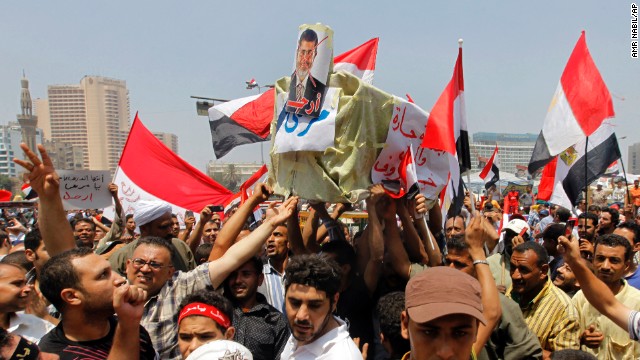 Opponents of Morsy shout slogans as they carry a symbolic coffin during a protest in Tahrir Square on July 3.
 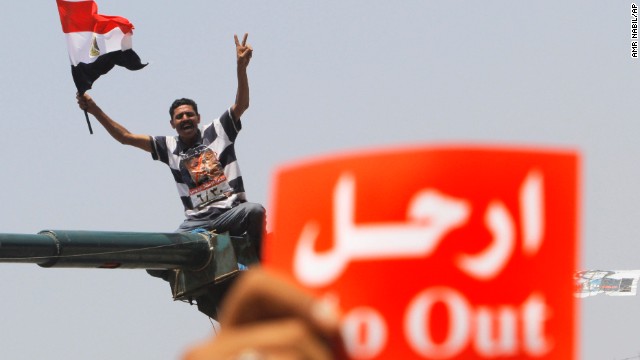 A protester shouts during a demonstration in Tahrir Square on July 3.
 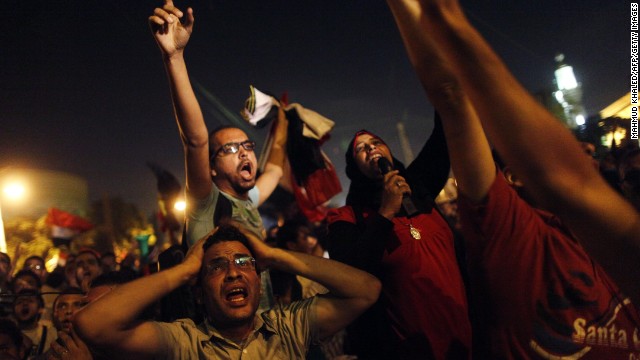 Protesters react after Morsy’s speech in a street leading to the presidential palace in Cairo early on July 3. Morsy’s angry opponents met head-on overnight with his supporters at Cairo University, leaving 23 people dead.
 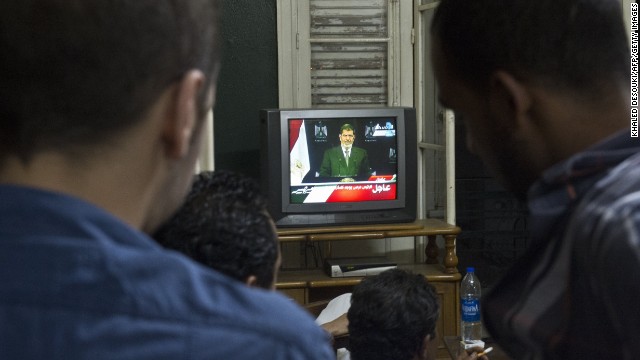 People watch Morsy on television in Cairo on Tuesday, July 2.
 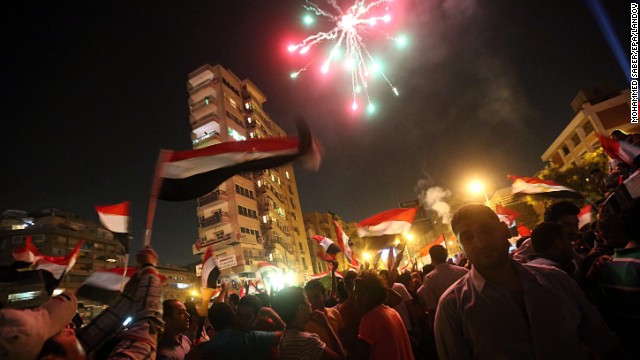 Fireworks go off as protesters gather in the streets outside the presidential palace in Cairo on July 2.
 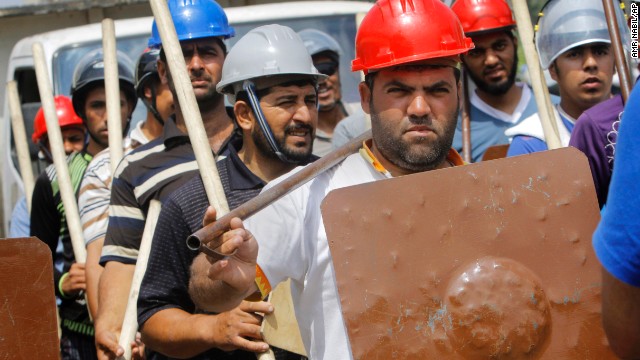 Supporters of President Morsy hold sticks and wear protective gear during training outside a mosque in Cairo on July 2.
 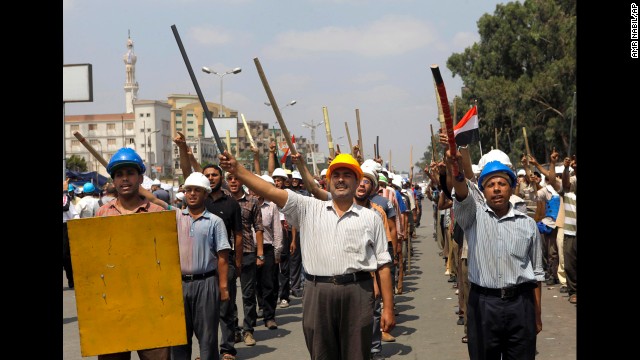 Morsy supporters march in formation in Cairo on July 2.
 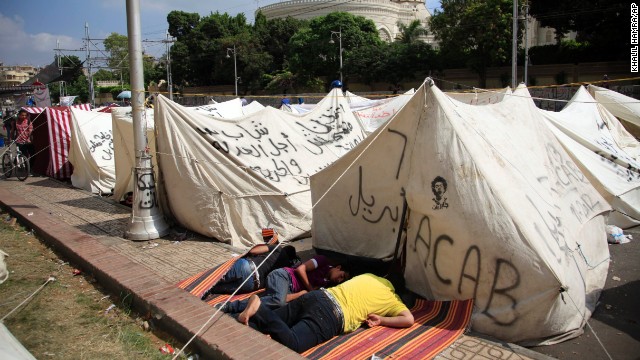 Opponents of Morsy camp out as they protest outside the presidential palace in Cairo on July 2.
 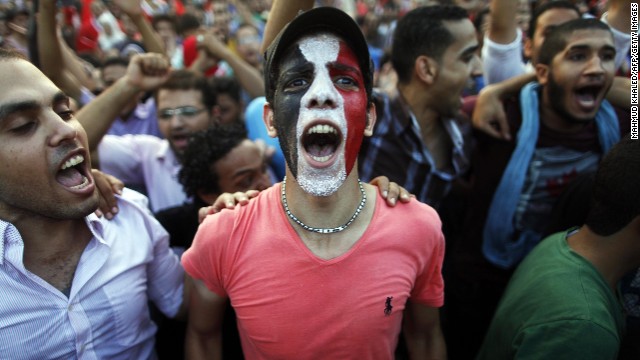 Egyptians shout slogans against Morsy in Cairo on Monday, July 1.
 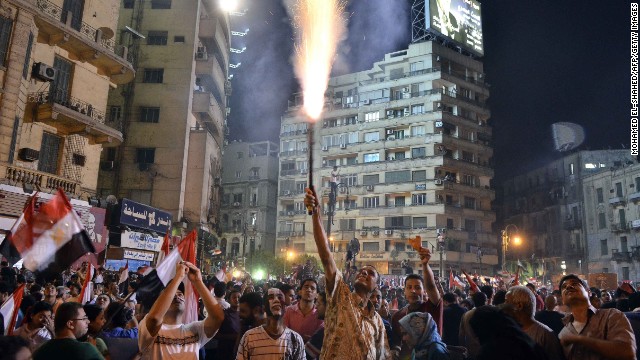 A protester lights a flare as hundreds of thousands of demonstrators gather in Cairo’s landmark Tahrir Square on July 1 during a protest calling for the ouster of Morsy.
 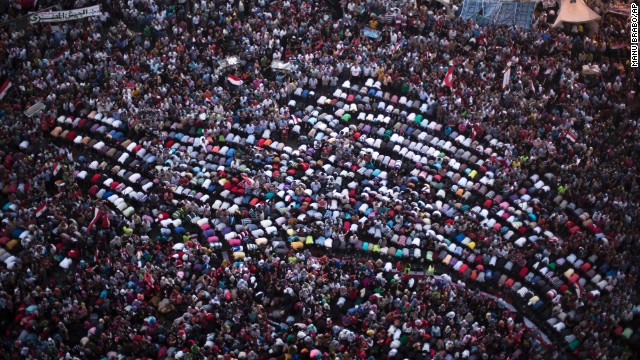 Protesters pray during a demonstration against Morsy in Cairo’s Tahrir Square on Monday, July 1. Pro- and anti-government demonstrations have spread around the country surrounding the one-year mark of Morsy coming into office on Sunday, June 30.
 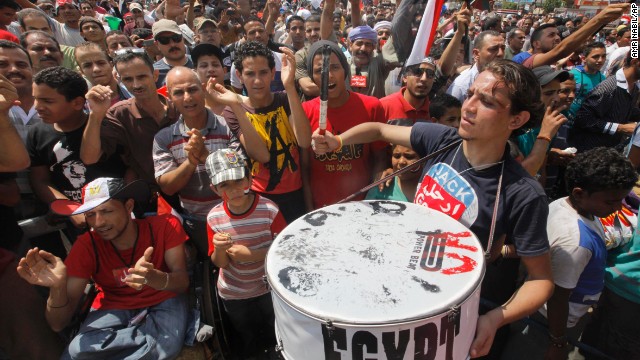 Egyptian protesters shout slogans and wave national flags during a demonstration against President Mohamed Morsy in Tahrir Square in Cairo on July 1.
 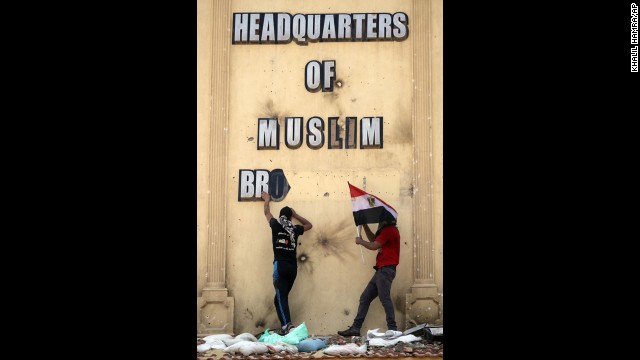 Egyptian protesters ransack the Muslim Brotherhood headquarters in the Muqatam district in Cairo on July 1. Protesters stormed and ransacked the headquarters of Morsy’s Muslim Brotherhood group early Monday.
 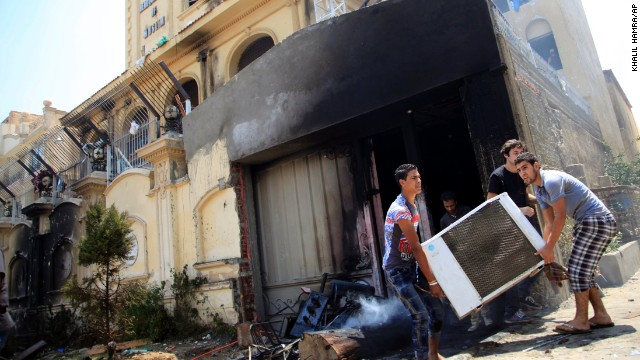 Egyptian protesters ransack the Muslim Brotherhood headquarters in Cairo on July 1.
 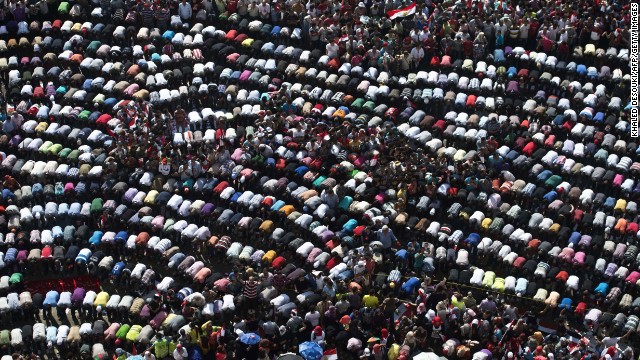 Thousands of opponents of Egyptian President Mohamed Morsy pray during a protest calling for his ouster at Cairo’s landmark Tahrir Square on June 30. On the first anniversary of his inauguration, Morsy’s Islamist supporters vow to defend his legitimacy to the end.
 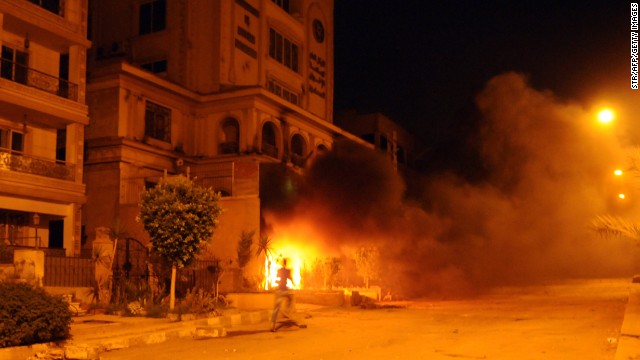 Protesters stormed the main headquarters of the Muslim Brotherhood in Cairo, the party that Morsy led before his election, and set it on fire on June 30.
 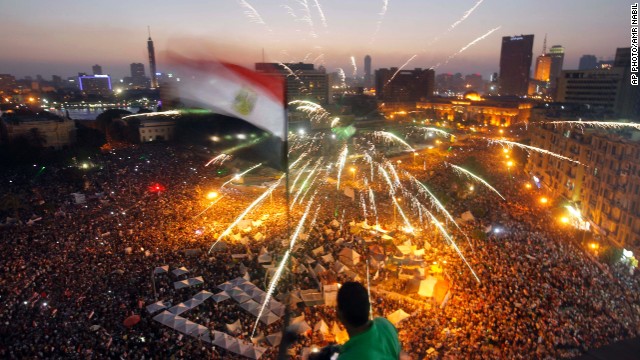 Morsy’s opponents say his policies are to blame for a breakdown in law and order, for an economy that’s gone south, and for a gas shortage that has Egyptians waiting at the pumps for hours. Here, protestors fill the streets of Cairo on June 30.
 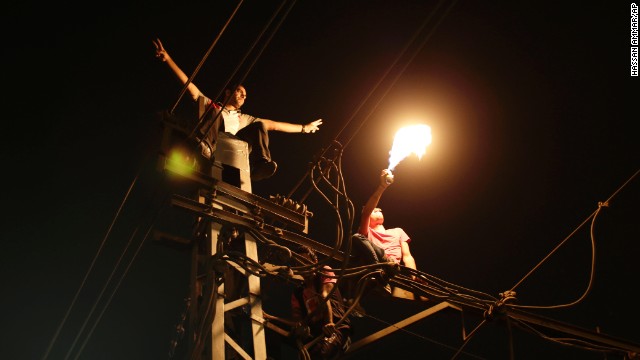 Protesters sit on top of a power pole as they chant slogans against Morsy outside the presidential palace in Cairo on June 30. “Egypt is on the brink of a volcano,” government-run newspaper Al-Akhbar said.
 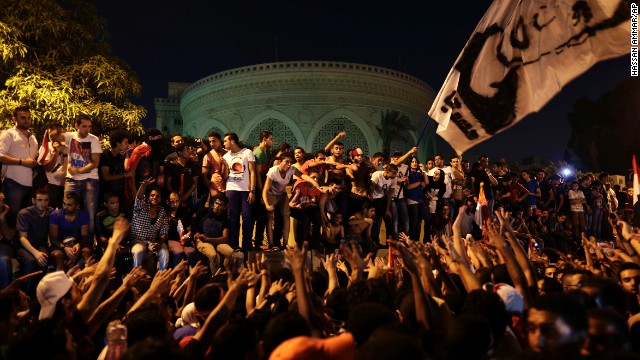 Periodically, Morsy opponents and supporters have clashed and the results have been deadly — even before the Sunday clashes.
 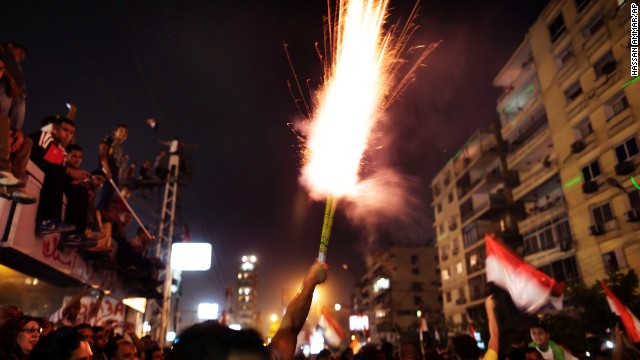 Protesters set off fireworks outside the presidential palace.
 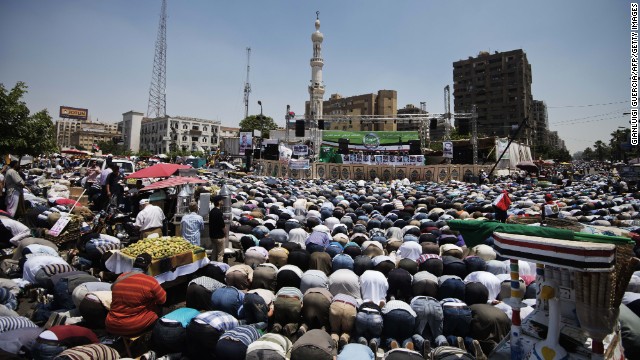 Thousands of Muslim Brotherhood supporters conduct Friday prayers in front of a Cairo mosque before the start of a sit-in for Morsy on June 28.
 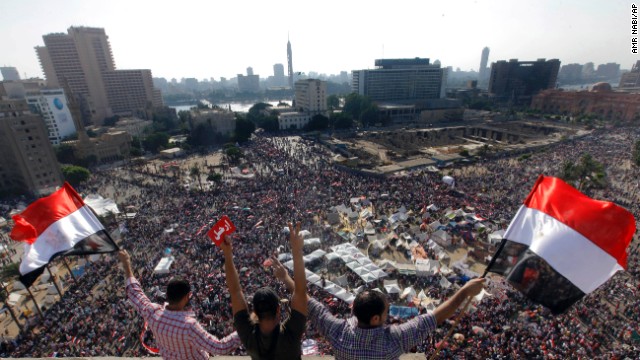 Protesters wave national flags and a red card in Arabic reading “leave” in Tahrir Square during the demonstration against Morsy.
 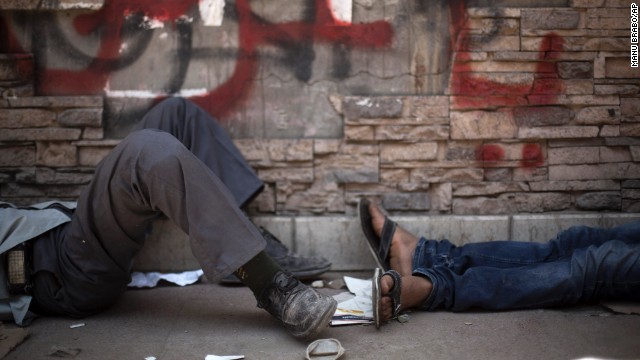 Protesters take a rest near Tahrir Square. Those supporting the president say he is the people’s choice and refer to the 13 million votes he earned in elections held exactly a year ago Sunday. They say he inherited a broken system and should be given time to fix it.
 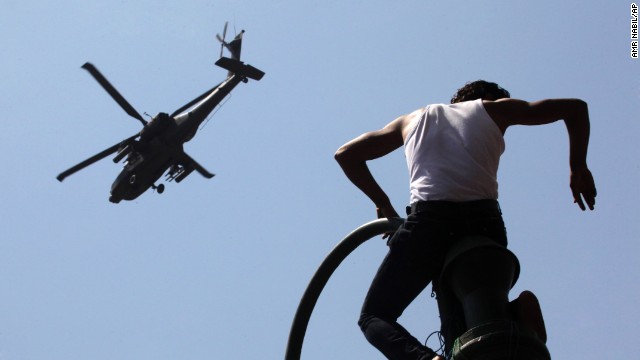 A protester watches an Apache helicopter as it flies over Tahrir Square on June 30. Morsy’s opponents stood their ground in the square, where protests two years ago helped topple Hosni Mubarak’s 29-year rule.
 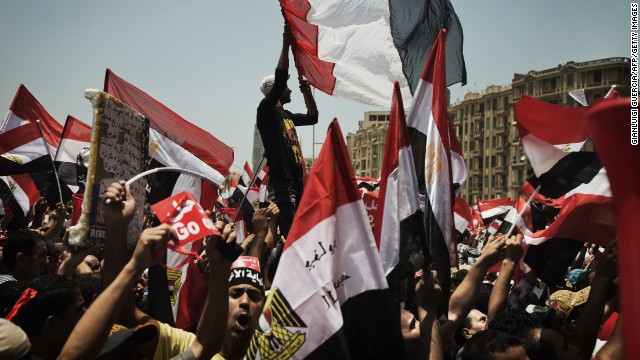 The demonstrators say they have collected 17 million signatures — roughly 4 million more than what won Morsy the presidency — and all of them call for Morsy to go.
 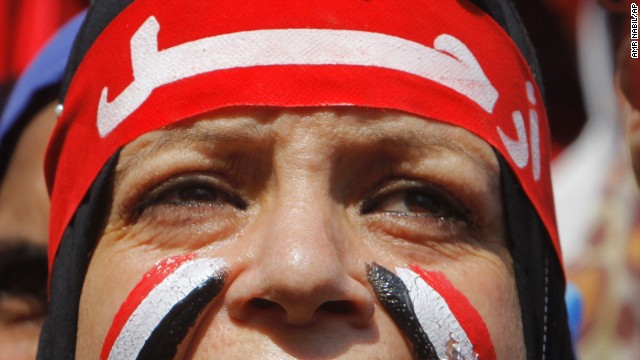 An Egyptian protester chants slogans during the rally.
 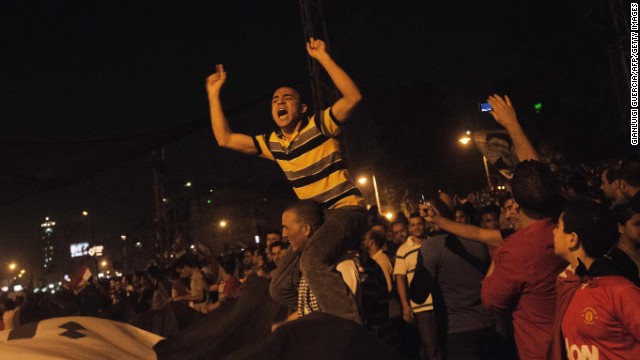 Hundreds of thousands of Morsy opponents chant outside the presidential palace.
 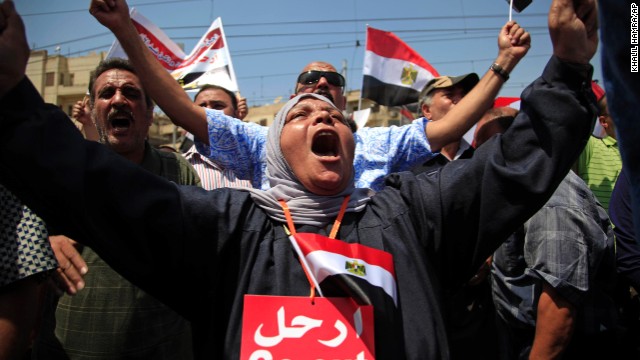 Morsy opponents protest outside the presidential palace in Cairo on June 30.
 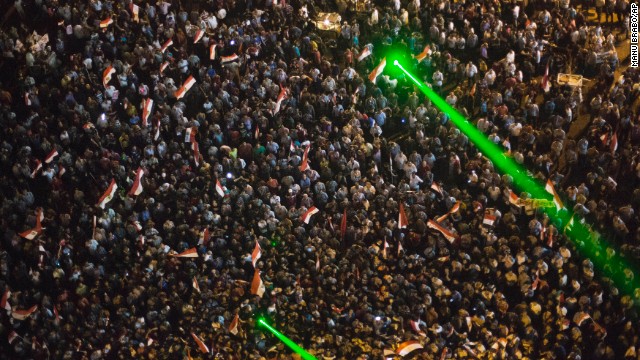 Thousands of Egyptian protesters gather in Tahrir Square. Anti-Morsy protesters have a wide range of views on why he should go and how to eject him from office.
 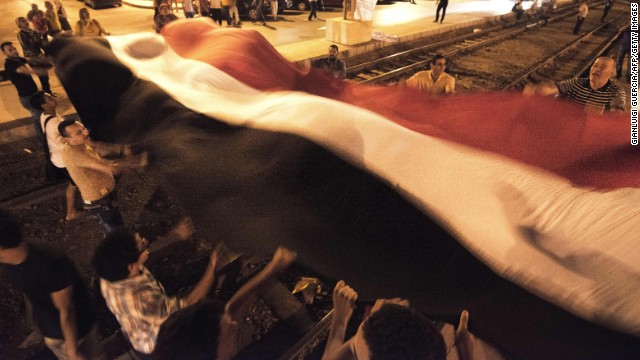 Morsy opponents wave a giant national flag outside the presidential palace on Saturday, June 29.
 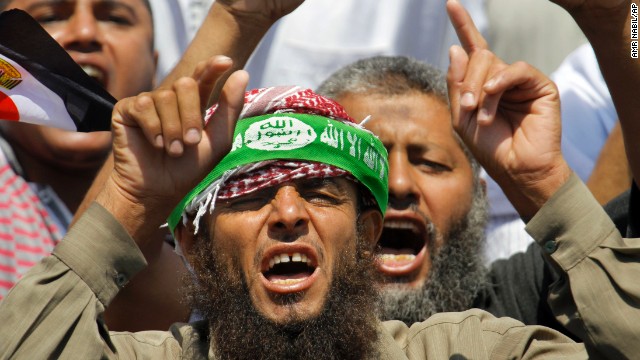 Supporters of the president shout slogans at the opposition near a mosque in Cairo on June 29. “We’re not leaving, and the president is staying,” one supporter told CNN. “We believe in democracy. If people don’t like him, they can vote him out in three years.”
 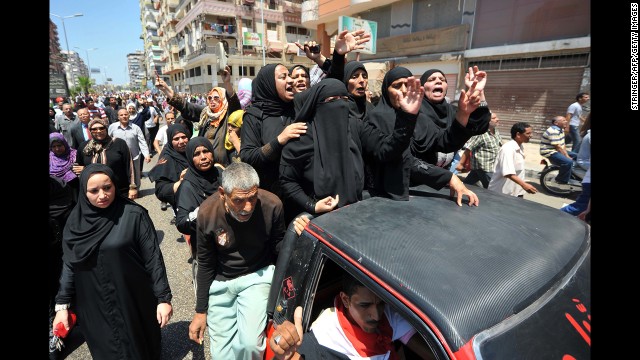 Mourners shout slogans during journalist Salah Hassan’s funeral on June 29 in Port Said.
 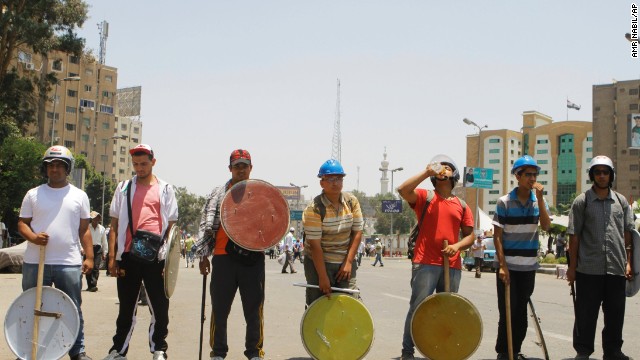 Morsy supporters, armed with sticks and shields, stand guard at their protest site in Cairo on June 29.
 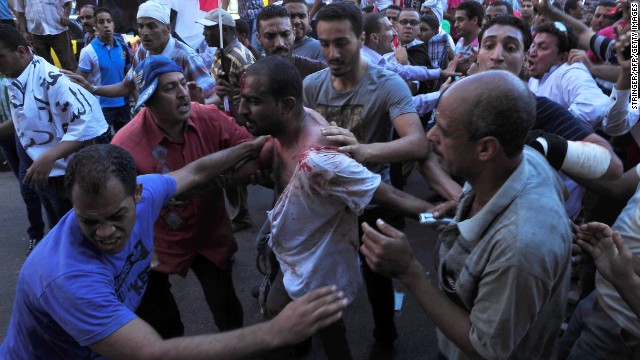 Egyptians help a wounded man following clashes between Morsy’s supporters and opponents in Alexandria on June 28.
 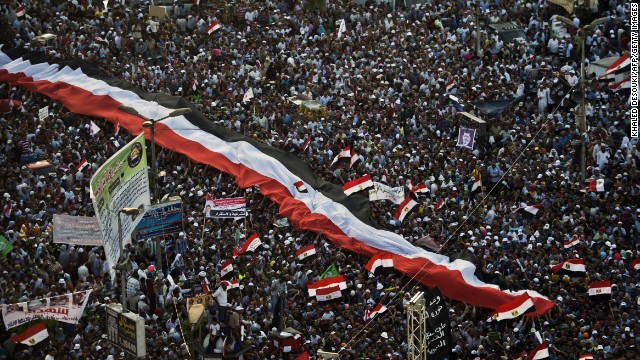 Morsy supporters demonstrate in Cairo on June 28. Protests have also erupted in Suez, Sharqia, El Monofia and Gharbiya, the state-run Ahram news agency said. And in the port city of Alexandria, so many people turned out that traffic virtually came to a standstill.
 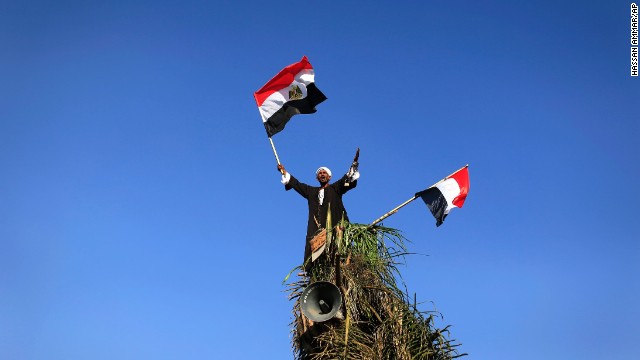 A Morsy opponent waves Egyptian flags during a protest outside the Egyptian Defense Ministry in Cairo on June 28.
 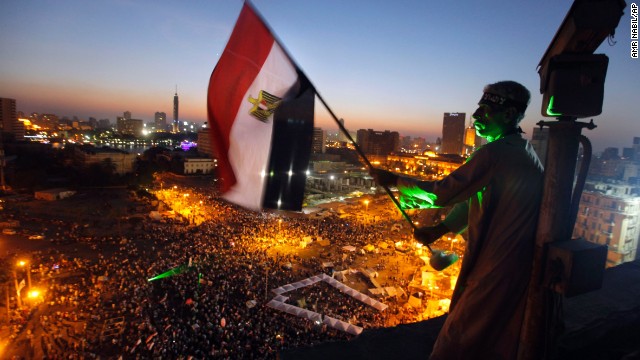 A protester waves a national flag over Cairo’s Tahrir Square. Demonstrator Rifaat Ali traveled from Upper Egypt to the capital with a message to Morsy’s opponents: “Our patience has run out. Either you back off, or the only thing left to do is attack with one fist.”
 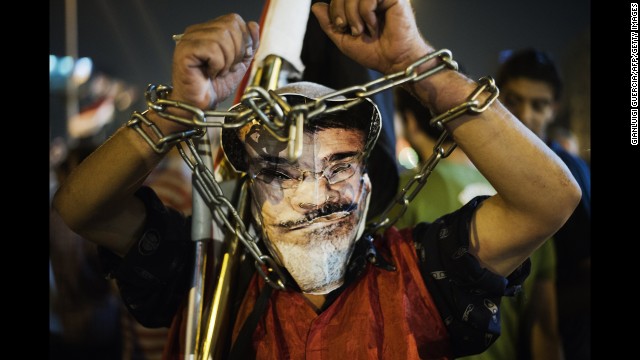 A chained protester wearing a picture of Morsy participates in an anti-government protest in Tahrir Square on Wednesday, June 26.
 Protests in Egypt
Protests in Egypt
Protests in Egypt
Protests in Egypt
Protests in Egypt
Protests in Egypt
Protests in Egypt
Protests in Egypt
Protests in Egypt
Protests in Egypt
Protests in Egypt
Protests in Egypt
Protests in Egypt
Protests in Egypt
Protests in Egypt
Protests in Egypt
Protests in Egypt
Protests in Egypt
Protests in Egypt
Protests in Egypt
Protests in Egypt
Protests in Egypt
Protests in Egypt
Protests in Egypt
Protests in Egypt
Protests in Egypt
Protests in Egypt
Protests in Egypt
Protests in Egypt
Protests in Egypt
Photos: Protests in Egypt
Protests in Egypt
Protests in Egypt
Protests in Egypt
Protests in Egypt
Protests in Egypt
Protests in Egypt
Protests in Egypt
Protests in Egypt
HIDE CAPTION
<<
<</span>

1

2

3

4

5

6

7

8

9

10

11

12

13

14

15

16

17

18

19

20


>
>>
Photos: Protests in Egypt  “Will sacrifice our blood”
 Egypt sees a rise in sexual abuse
The only group in the country that has not been happy is the Muslim Brotherhood and some of their fellow Islamist parties. Rather than working on a solution to the political crisis, the leaders of the Brotherhood have responded by mobilizing their followers with insane religious rhetoric to start jihad against the opposition.
On Tuesday night Morsy himself made a long speech about his alleged legitimacy: he said blatantly that he is willing to protect this with blood and that he will only give it away is when he is dead.
For many Arabic listeners those words will be clear incitement to jihad: many of Morsy’s followers may be fooled by the fact that he got his legitimacy from God as an Islamist president. A few minutes after the speech, violent clashes started at several locations across Egypt, resulting in fatalities.
Meanwhile, some international observers have described what is now happening in Egypt as a soft military coup. I reject those short-sighted claims as an Egyptian who proudly planned for and participated in the toppling of Mubarak in 2011; who condemned the Supreme Council of the Armed Forces (SCAF) which governed after Mubarak in 2012 but then failed us; and who has planned for and is now protesting against the Muslim Brotherhood from a determination to establish a liberal democracy in Egypt.
There is nothing to suggest that the military is implementing or even plotting a coup. Monday’s critical move by the military in favor of the people comes from a patriotic sentiment: to protect the people, with whom they are an integral part and to whom they hold the utmost responsibility to protect and empower.
 Egypt in turmoil
 Video shows clashes at Cairo University
 Photos, videos capture Egypt in crisis
In March, the Ibn Khaldun Center for Development Studies ran a public opinion poll asking Egyptians whether they see the return of the military as a solution for the cumulative political and economic failures of the Morsy regime. The poll showed that 82% of those surveyed supported the return of the military to power. The majority of the sample were young people under the age of 35, most of whom were protesting against the SCAF a few months before the Muslim Brotherhood came to power. Those results strongly reflect the huge support we are now witnessing.
The people trust the military more than they trust any other institution in the country. This is partly because of the military’s historical legacy that has left it as the strongest in the region. Another important reason is that military officers, who are very much part of the fabric of the country, are very patriotic and loyal to noone but Egypt. Much of this is because the military has sustained a professionalism that has allowed it to be independent in making its own decisions. The interests of the military are not dependent on the interests of the regime or any supreme authority in Egypt.
That is why it was easy for the military to abandon Mubarak in 2011 in favor of the people, something that the police, for example, could not do because their existence relied heavily on the existence of the then regime. Mubarak’s Egypt was not a military state: rather it was a police state that abused the armed power of the police to fasten the regime’s grip on the neck of the opposition.
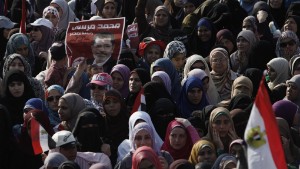 All eyes on Egyptian military’s deadline
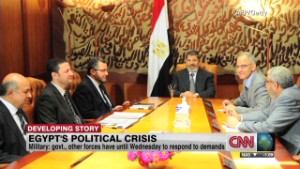 Egyptian ministers resign amid unrest
Therefore, many Egyptian people believe the military when they say that they are not interested in playing a political role or ruling again. It is in the best interests of the military to remain neutral and independent. We were ruled by the SCAF after the fall of Mubarak: after that, both the military and the people knew very well that military leaders cannot be good politicians.
The military and the people are now looking for the right civil leader who can lead a liberal democratic state. As soon as Morsy is brought down, the people and the military need nothing more than to agree on a clear roadmap and a specific timeframe to make this happen as soon as possible.
Many observers have asked why those people who protested against SCAF a year ago are now warmly welcoming their return. I have the answer. We realized that we committed a huge mistake when we wanted to accelerate the process of democratization by rushing into presidential elections before drawing up a constitution first.
This mistake has cost us a full year of endless failures and problems. What we are doing today is taking one step backwards to where we were before the Muslim Brotherhood came to power and restarting again on the right foot.
The opinions expressed in this commentary are solely those of Dalia Ziada.
Continue reading here:
Why Egyptians welcome the army
The post Why Egyptians welcome the army appeared first on Arne Ruhnau News.
via Arne Ruhnau News http://arneruhnau.com/why-egyptians-welcome-the-army/

No comments:
Post a Comment