
STORY HIGHLIGHTS
- He is convicted of 13 counts of murder, 32 counts of attempted murder
- Death penalty may be considered as a punishment
- Hasan has admitted killing 13 people and wounding 32 others
Fort Hood, Texas (CNN) — A military jury on Friday convicted Army Maj. Nidal Hasan of 13 counts of murder and 32 counts of attempted murder in a November 5, 2009, shooting rampage at Fort Hood, Texas, making it possible for the death penalty to be considered as a punishment.
The jurors deliberated fewer than seven hours over two days to hand down a verdict against Hasan, who admitted to targeting soldiers he was set to deploy with to Afghanistan to protect the Taliban and its leaders. The shooting rampage occurred at a deployment processing center.
The court-martial next moves to the penalty phase, where Hasan — acting as his own attorney — will have the opportunity to address the jurors considering whether he should be executed for his actions.
Deliberating since Thursday afternoon
On Thursday afternoon, a judge handed the case to the jury, a panel of 13 senior officers, after 12 days of testimony.
After nearly three hours of deliberations, the panel asked to rehear the testimony of the police officer who shot Hasan, ending the rampage that left 13 people dead and dozens wounded.
Jurors also asked to see a map marked by the police officer, Mark Todd, indicating where he shot Hasan.
The questions appeared to indicate that the jury was evaluating the charge — premeditated attempted murder — against Hasan for firing at Todd, who was not wounded in the attack.

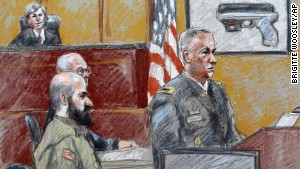 Hasan trial: A suicide mission?
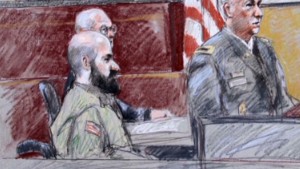 Fort Hood shooter rests his case
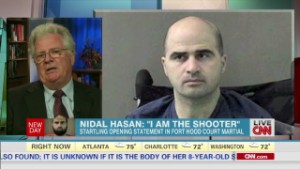 Nidal Hasan: ‘I am the shooter’
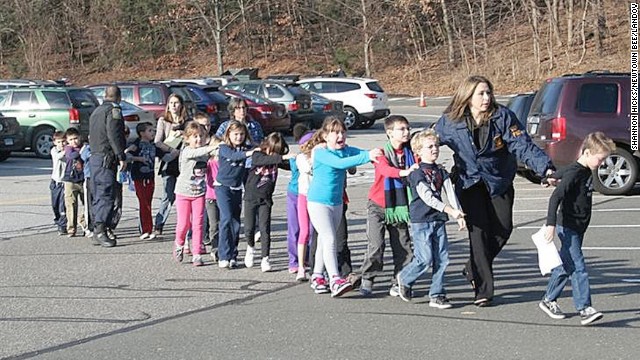 Connecticut State Police evacuate children from Sandy Hook Elementary School in Newtown, Connecticut, on December 14, 2012. Adam Lanza opened fire in the school, killing 20 children and six adults before killing himself. Police say he also shot and killed his mother in her Newtown home.
 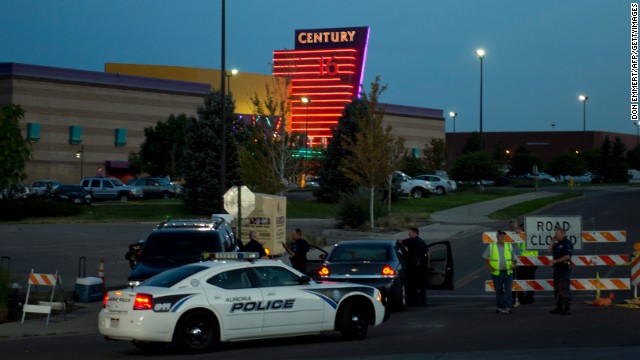 James Holmes pleaded not guilty by reason of insanity to opening fire June, 20, 2012, at the Century Aurora 16 theater in Aurora, Colorado, during the midnight premiere of “The Dark Knight Rises.” Twelve people were killed and dozens were wounded. Holmes is charged with 142 counts, including first-degree murder. His trial is scheduled to begin in February 2014.
 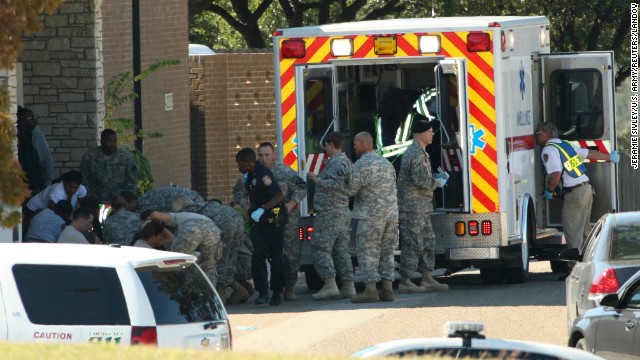 Army psychiatrist Maj. Nidal Malik Hasan is accused of opening fire on November 5, 2009, at the Fort Hood military base in Texas. A gunman killed 13 people and injured 32. Hasan is charged with 13 counts of premeditated murder and 32 counts of attempted murder. His trial is set to begin August 6.
 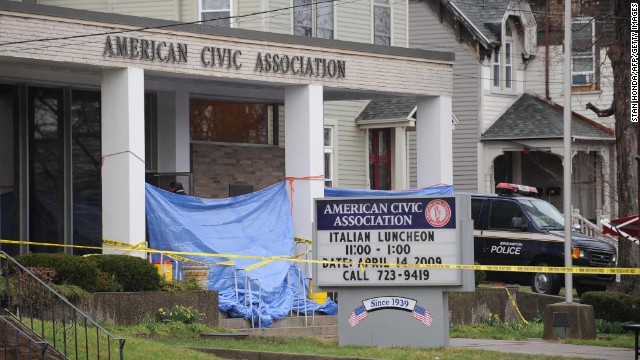 Jiverly Wong shot and killed 13 people at the American Civic Association in Binghamton, New York, before turning the gun on himself on April 3, 2009, police say. Four other people were injured at the immigration center shooting. Wong had been taking English classes at the center.
 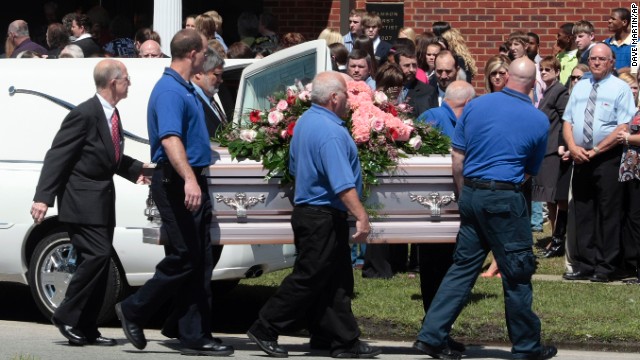 Pallbearers carry a casket of one of Michael McLendon’s 10 victims. McLendon shot and killed his mother in her Kingston, Alabama, home, before shooting his aunt, uncle, grandparents and five more people. He shot and killed himself in Samson, Alabama, on March 10, 2009. McClendon left a note saying he put his mother “out of her misery.”
 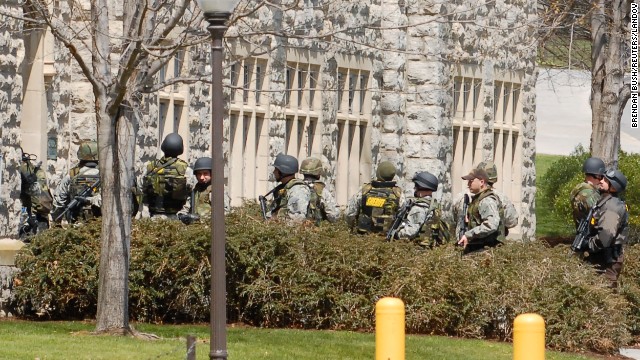 Virginia Tech student Seung-Hui Cho went on a shooting spree on the campus in Blacksburg, Virginia, on April 16, 2007. Cho killed two people at the West Ambler Johnston dormitory and, after chaining the doors closed, killed another 30 at Norris Hall, home to the Engineering Science and Mechanics Department. He wounded 17 people before killing himself. It is the deadliest shooting rampage in U.S. history.
 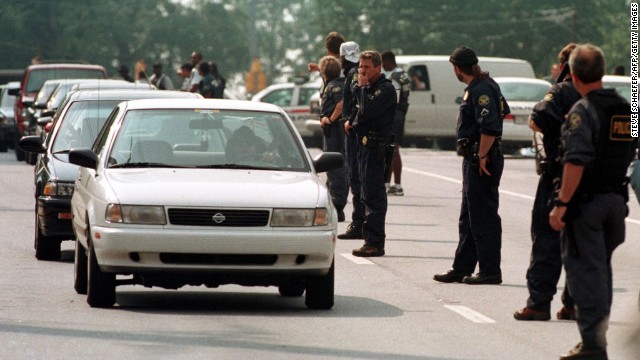 Mark Barton walked into two Atlanta trading firms on July 29, 1999, and fired shots, leaving nine dead and 13 wounded, police say. Hours later police found Barton at a gas station in Acworth, Georgia, where he pulled a gun and killed himself. The day before Barton had bludgeoned his wife and his two children in their Stockbridge, Georgia, apartment, police say. The children’s birth mother and grandmother had been murdered six years earlier in Alabama. Barton was questioned but never charged in that crime.
 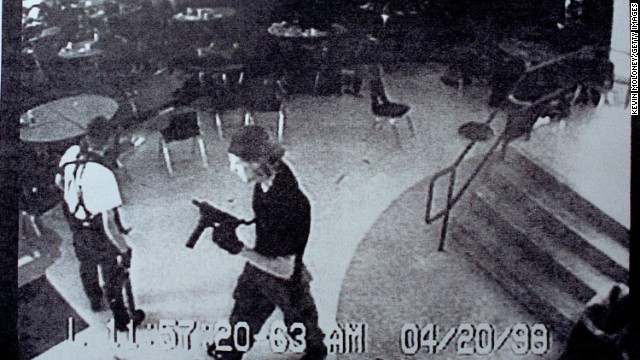 Eric Harris, left, and Dylan Klebold entered Columbine High School in Littleton, Colorado, on April 20, 1999, armed with bombs and guns. The students killed 13 and wounded 23 before killing themselves.
 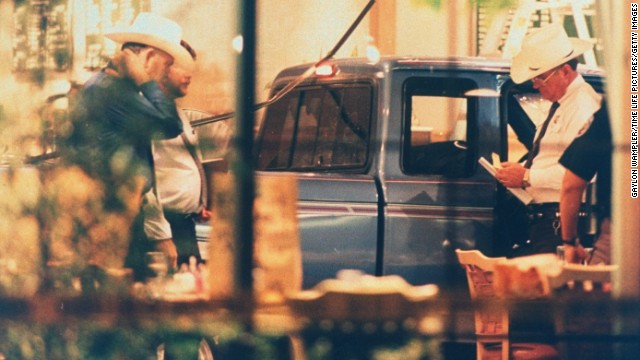 George Hennard crashed his pickup through the plate glass window of Luby’s Cafeteria in Killeen, Texas, on October 16, 1991, before fatally shooting 23 people and committing suicide.
 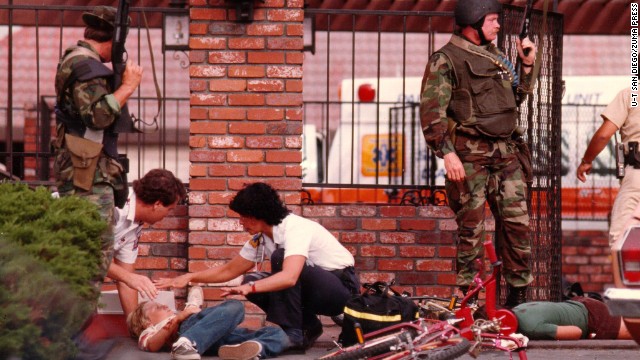 James Huberty shot and killed 21 people, including children, at a McDonald’s in San Ysidro, California, on July 18, 1984. A police sharpshooter killed Huberty an hour after the rampage began.
 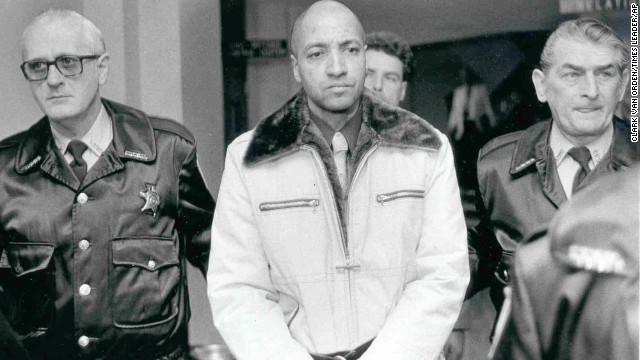 Prison guard George Banks is led through the Luzerne County courthouse in 1985. Banks killed 13 people, including five of his children, in Wilkes-Barre, Pennsylvania, on September 25, 1982. He was sentenced to death in 1993 and received a stay of execution in 2004. His death sentence was overturned in 2010.
 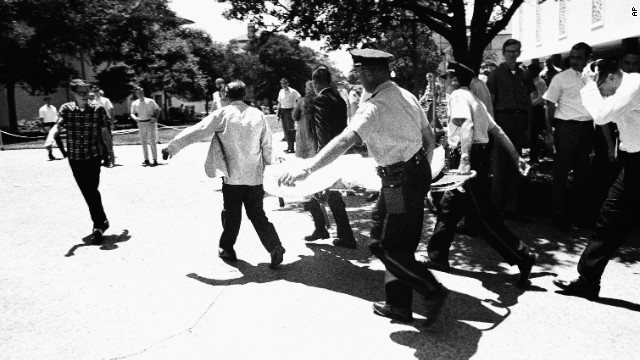 Officers carry victims across the University of Texas at Austin campus after Charles Joseph Whitman opened fire from the school’s tower, killing 16 people and wounding 30. Police officers shot and killed Whitman, who had killed his mother and wife earlier in the day.
 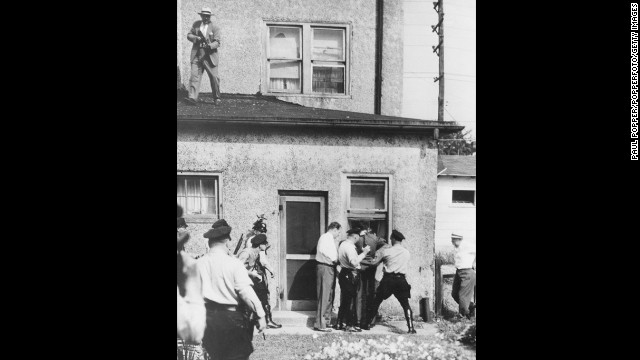 Howard Unruh, a World War II veteran, shot and killed 13 of his neighbors on September 5, 1949, In Camden, New Jersey. Unruh barricaded himself in his house after the shooting; police overpowered him the next day. He was ruled criminally and committed to a state mental institution.
 Worst mass shootings in U.S.
Worst mass shootings in U.S.
Worst mass shootings in U.S.
Worst mass shootings in U.S.
Worst mass shootings in U.S.
Worst mass shootings in U.S.
Worst mass shootings in U.S.
Worst mass shootings in U.S.
Worst mass shootings in U.S.
Worst mass shootings in U.S.
Worst mass shootings in U.S.
Worst mass shootings in U.S.
Worst mass shootings in U.S.
HIDE CAPTION
<<
<</span>

1

2

3

4

5

6

7

8

9

10

11

12

13
>
>>
Photos: Worst mass shootings in U.S. Later, the judge reconvened the court-martial so that the jury could ask two questions about paperwork.
Hasan doesn’t call witnesses, give closing argument
The jury began deliberations after Hasan declined to make a statement during closing arguments.
The prosecution urged the jury to convict, saying the evidence showed that he believed he had a jihad duty to kill as many soldiers as possible.
“There is no doubt, as I said in the beginning, the accused is the shooter,” the prosecutor, Col. Steven Henricks, told the jury.
“The only question for you is … is this a premeditated design to kill?”
For more than 90 minutes, the prosecutor took the jury methodically through the evidence in the case, meticulously piecing together how he says Hasan prepared and planned for the attack.
Soldier on soldier attacks Fast Facts
Prosecutors have maintained that the American-born Muslim underwent a progressive radicalization that led to the massacre at the sprawling central Texas base.
“He did not want to deploy, and he came to believe he had a jihad duty to kill as many soldiers as possible,” Henricks told the jury.
Hasan picked the day — November 5, 2009 — because it was when the units he was scheduled to deploy with to Afghanistan were scheduled to go through the processing center, he said.
Hasan rested his case without calling a single witness or taking the stand to testify on his own behalf.
His decision not to offer a defense was an anticlimactic end to the trial in which prosecution witnesses, primarily survivors, painted a horrific picture of what unfolded inside a processing center during the attack.
A graphic FBI video during closing arguments
During closing arguments, prosecutors showed a graphic FBI video of the crime scene hours after the rampage, where bodies, blood and bullets still covered the floor.
As the video was shown to the jury, some of the family members of those killed fought back tears.
One woman laid her head on her husband’s shoulder, tears pouring down her cheeks, while another woman, a wife of a victim, left the courtroom.
For his part, Hasan watched the video, appearing to pay close attention.
Hasan, who has insisted that the jury not be allowed to consider lesser charges against him, said his attack on soldiers at Fort Hood was not an act of “sudden passion.”
Fort Hood victims feel betrayed
There was “adequate provocation” for the attack because the soldiers were going to participate in “an illegal war” in Afghanistan, Hasan told the military judge Wednesday, arguing against the jury being allowed to consider voluntary manslaughter or unpremeditated murder.
Prosecutors argued against the inclusion of lesser charges, saying the attack wasn’t carried out in “the heat of sudden passion,” and Hasan said he agreed.
The judge ruled that the jurors can consider a lesser charge of unpremeditated murder but not voluntary manslaughter. They can also consider unpremeditated attempted and other lesser charges, she ruled.
Hasan’s defense
Much has been made of Hasan’s defense or, as his stand-by attorneys have said, the lack of it. Judge Tara Osborn declined a request by Hasan’s attorneys to drop out of the case. The attorneys argued that Hasan was helping the prosecution put him to death.
There may be something to that claim.
Hasan took credit for the shooting rampage at the outset of the trial, telling the jury during opening statements that the evidence will show “I was the shooter.”
Osborn barred Hasan from pleading guilty at the start of the court-martial. Under military law, defendants cannot enter guilty pleas in capital punishment cases.
The judge has refused to allow Hasan to argue “defense of others,” a claim that he carried out the shootings to protect the Afghan Taliban and its leaders from U.S. soldiers.
Perhaps as a way around that ruling, Hasan in recent days has leaked documents through his civilian attorney to The New York Times and Fox News that offer a glimpse of his justification for carrying out the attack. Among the documents was a mental health evaluation conducted by a military panel to determine whether Hasan was fit to stand trial.
“I don’t think what I did was wrong because it was for the greater cause of helping my Muslim brothers,” he told the panel, according to pages of the report published by The New York Times.
He also said, according to the documents: “I’m paraplegic and could be in jail for the rest of my life. However, if I died by lethal injection, I would still be a martyr.”
Prosecutors call dozens of witnesses
Military prosecutors called 89 witnesses and submitted more than 700 pieces of evidence before resting their case.
The judge excluded much of the evidence that the prosecution contends goes to the heart of the motive for the attack, including e-mail communications between Hasan and Anwar al-Awlaki, the U.S.-born cleric who officials say became a key member of al Qaeda in the Arabian Peninsula. He was killed in a U.S. drone strike in 2011.
Osborn also declined to allow prosecutors to use materials they maintain showed Hasan’s interest in the actions of Army Sgt. Hasan Akbar, the American soldier sentenced to death for killing two soldiers and wounding more than a dozen others at the start of the Iraq war, an attack he said he carried out to stop soldiers from killing Muslims.
Along with the e-mails and the material related to Akbar, Osborn declined to allow the use of Hasan’s academic presentation on suicide bombings, saying “motive is not an element of the crime.”
‘;
document.write(OB_MarkUP);
if (typeof(OB_Script)!=’undefined’)
OutbrainStart();
else{
var OB_Script=true;
var str=”
Link to original:
Fort Hood shooting: Hasan guilty
The post Fort Hood shooting: Hasan guilty appeared first on Arne Ruhnau News.
via Arne Ruhnau News http://arneruhnau.com/fort-hood-shooting-hasan-guilty/

No comments:
Post a Comment